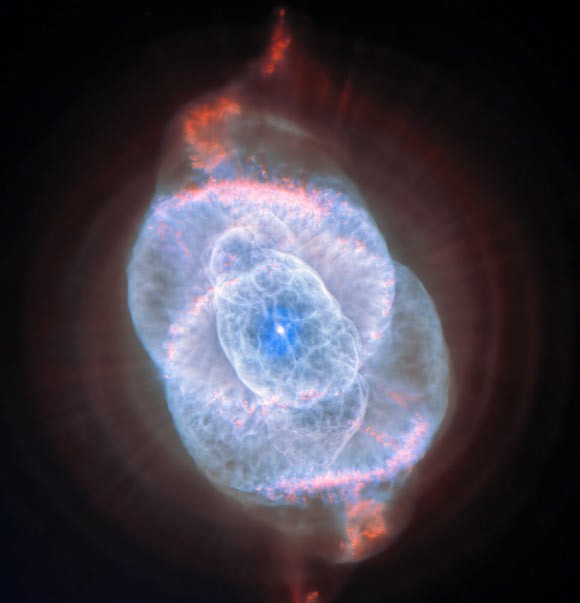
New observations from the Hubble and Euclid space telescopes have unveiled unprecedented detail in the Cat’s Eye Nebula (NGC 6543), a dying star’s final, spectacular exhale located 4,300 light-years away in the Draco constellation. The images reveal a complex, layered structure that astronomers say resembles a cosmic fossil record of the star’s last moments.
The Science of Stellar Death
Planetary nebulae, despite the name, have nothing to do with planets. They are expanding clouds of gas ejected by aging stars as they run out of fuel. This process was first understood in 1864, when scientists observed that the light spectrum of nebulae contained molecules, proving they were gas clouds rather than distant stars or galaxies.
The Cat’s Eye Nebula is particularly striking because of its intricate rings and filaments. The newest images from Euclid show a halo of gas fragments surrounding a central region, indicating that the star shed material in multiple phases.
Hubble’s Detailed View
Hubble’s high-resolution images focus on the nebula’s core, exposing concentric shells, jets, and dense knots created by shock waves. These structures aren’t random; they represent distinct episodes of mass loss from the dying star. Each layer is a snapshot in time, showing how the star’s outer layers were shed before its final collapse.
“These structures are believed to record episodic mass loss from the dying star at the nebula’s center, creating a kind of cosmic ‘fossil record’ of its final evolutionary stages.”
Euclid’s Broader Context
Euclid’s observations provide a broader perspective, placing the nebula against a backdrop of distant galaxies. This highlights how local astrophysical phenomena like stellar death can coexist with the vastness of the cosmos. The combined data from both telescopes is not just aesthetically stunning; it’s scientifically valuable, offering a complete picture of the nebula’s structure and its place in the universe.
The Cat’s Eye Nebula serves as a powerful reminder that even in death, stars leave behind beautiful and informative legacies, providing insight into the life cycles of stars and the evolution of galaxies.
These findings underscore the power of collaborative astronomy, where different instruments working together can unlock deeper understandings of the universe.