
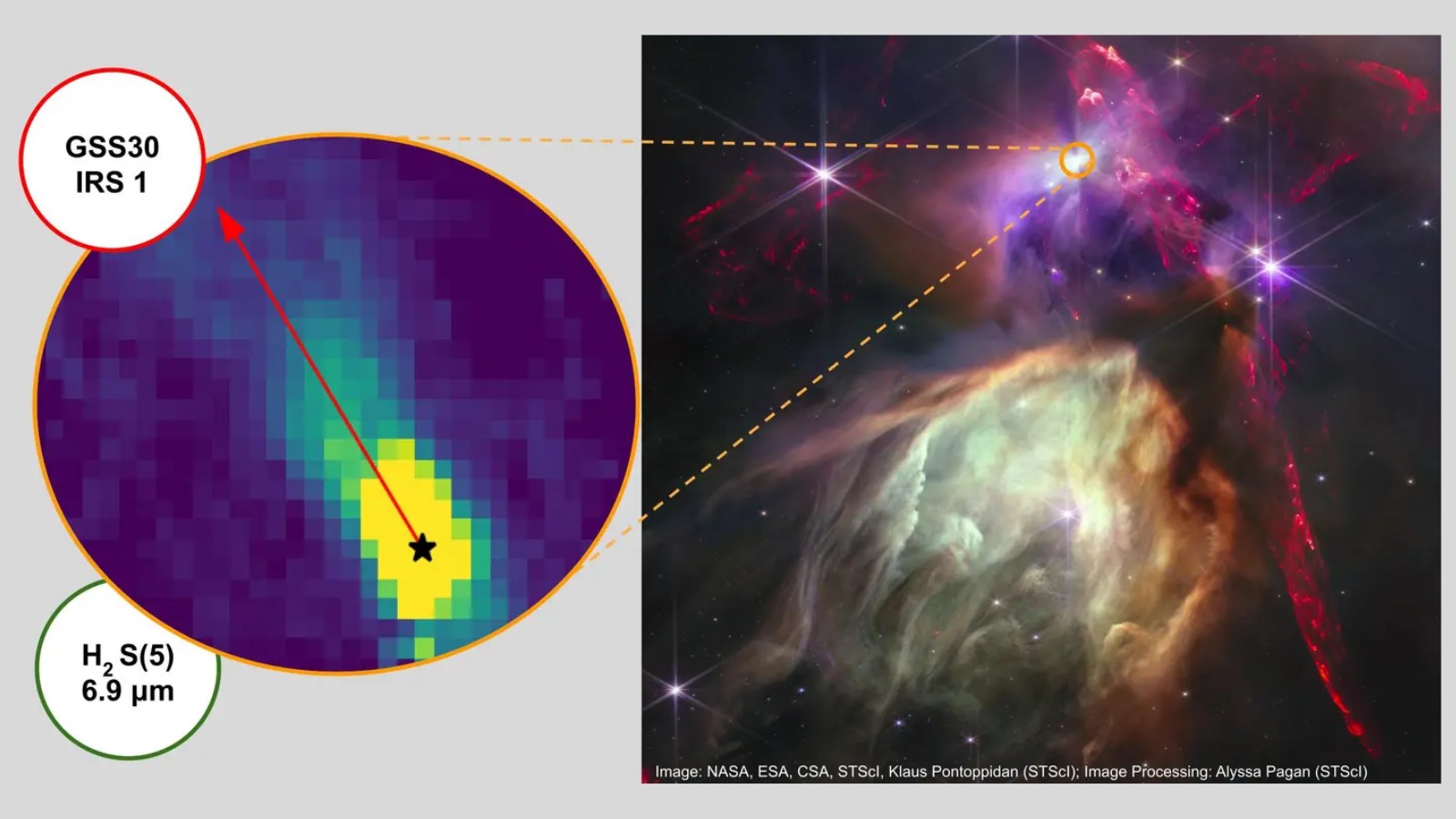

Astronomers using the James Webb Space Telescope (JWST) have discovered high-energy ultraviolet (UV) radiation surrounding five developing stars within the Ophiuchus star-forming region. This finding challenges existing models of how stars are born, as young protostars shouldn’t be capable of emitting such high-energy radiation.
The Puzzle of Early Stellar Radiation
Protostars represent the earliest stage in a star’s life cycle. They form when dense pockets of gas and dust collapse under gravity, gathering mass from their surroundings before igniting nuclear fusion in their cores. These young stars are expected to be buried within thick clouds of material, shielding them from producing significant UV radiation. The JWST’s observations reveal that this expectation isn’t always true.
Researchers from the Max Planck Institute and Nicolaus Copernicus University found that these protostars in the Ophiuchus cloud – located roughly 450 light-years away – exhibit UV emissions despite their early developmental stage. “This is the first surprise,” explains Agata Karska, from the Center for Modern Inter-disciplinary Technologies. “Young stars are not capable of being a source of radiation… and yet we have shown that UV occurs near protostars.”
How the Discovery Was Made
The team used JWST’s Mid-Infrared Instrument (MIRI) to study the Ophiuchus molecular cloud, which contains numerous young, energetic stars. By focusing on molecular hydrogen emissions – which become visible when shockwaves from stellar outflows heat the surrounding gas – they detected unexpected UV signatures. Molecular hydrogen is difficult to observe directly because its low temperature makes it invisible at many wavelengths. However, the JWST’s instruments allowed the team to trace these emissions and confirm the presence of UV radiation around the protostars.
Internal vs. External Sources
The source of the UV radiation remains a key question. Initial theories pointed to nearby massive stars emitting radiation that spilled onto the protostars. However, after accounting for the distances between stars and the dust’s ability to absorb UV light, researchers ruled out this external explanation. The consistency of the UV signature across protostars with varying external conditions suggests the radiation originates from processes within the protostar systems themselves.
Possible internal sources include shocks when material falls onto the protostar or powerful jets of matter erupting from the young star. The team plans to continue studying the region using JWST to analyze the gas, dust, and ice surrounding these developing stars, hoping to pinpoint the exact mechanism driving this unexpected radiation.
This discovery underscores that our understanding of star formation may be incomplete. The presence of UV radiation in protostars demands a reevaluation of how these early stellar systems function and interact with their surroundings.