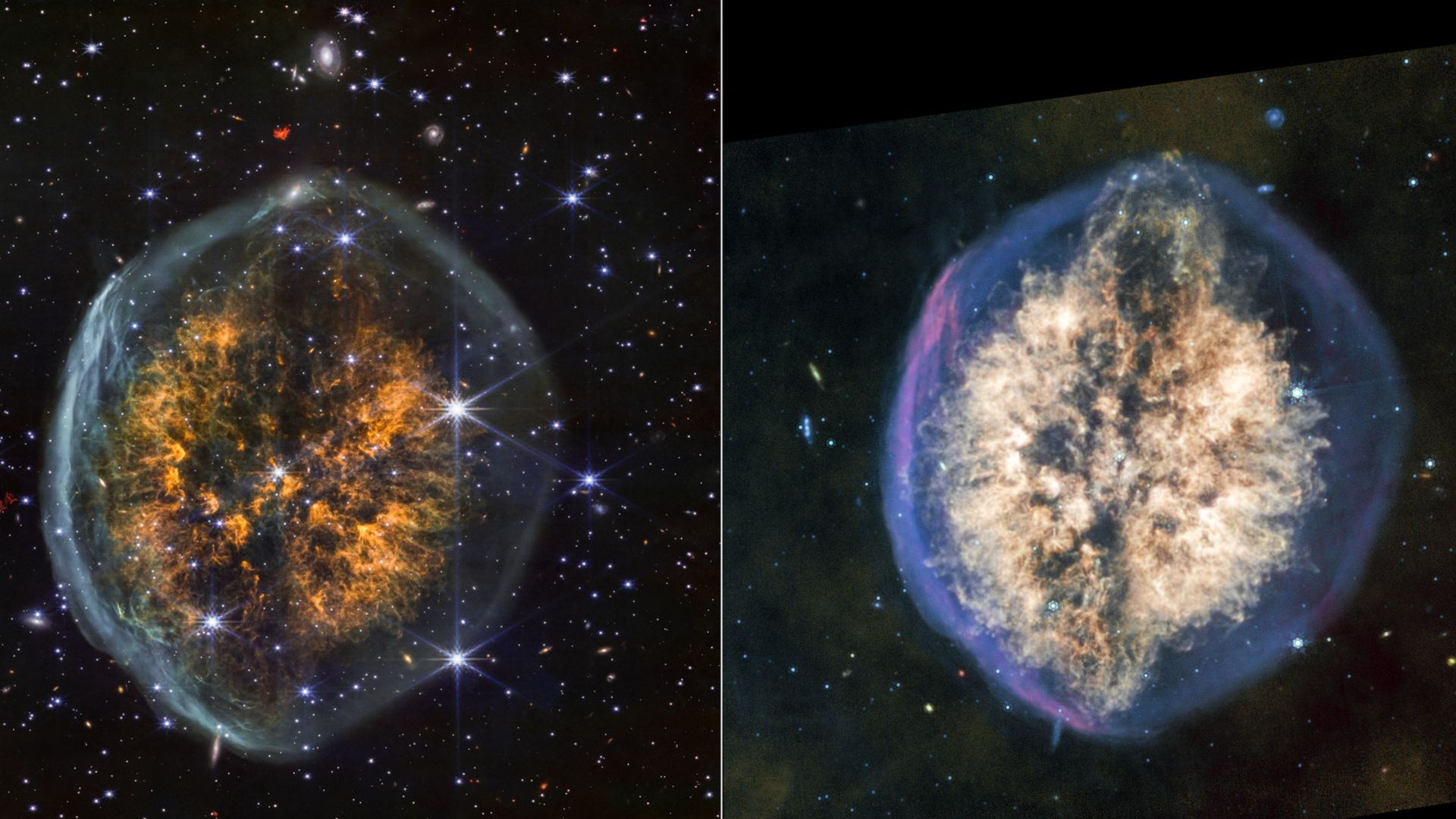

The James Webb Space Telescope (JWST) has captured breathtaking new images of PMR 1, a planetary nebula that strikingly resembles a human brain encased in a skull. This celestial object, first identified in 2014 but previously understudied, offers unique insights into the final stages of a dying star’s life cycle.
The Cosmic Cranium Explained
PMR 1 is not a brain, but an expanding shell of gas and dust ejected by a star as it runs out of fuel. The JWST’s advanced infrared imaging capabilities have revealed details invisible to earlier telescopes like Spitzer, highlighting the nebula’s complex structure in unprecedented clarity. The nickname “Exposed Cranium” comes from the nebula’s shape, which closely mimics a brain within a transparent skull.
Dual-Wavelength View: NIRCam and MIRI
The images are composed of data from two JWST instruments: the Near-Infrared Camera (NIRCam) and the Mid-Infrared Instrument (MIRI).
* NIRCam shows the outer shell glowing brightly, with a clear dark lane bisecting the nebula like cerebral hemispheres. Distant galaxies are visible through the outer layers.
* MIRI reveals a bluer, more complex internal structure, where the central dark lane is partially obscured by denser gas and dust.
This combination of observations is key: NIRCam provides high contrast, while MIRI reveals hidden details, together giving a more complete picture of PMR 1’s formation.
Stellar Evolution in Action
The nebula’s structure also reveals multiple stages of the star’s evolution. Outer shells represent earlier gas expulsions, while inner clouds show more recent activity. The star at the center of PMR 1 has two potential fates: either a violent supernova explosion or a slow fade into a dense white dwarf.
“Webb’s ability to see the universe in multiple wavelengths of light is so valuable to astronomers.”
The “Exposed Cranium” nebula is a reminder of the dynamic processes at work in the cosmos, where stars don’t simply die but put on spectacular final shows before either vanishing in a blaze of glory or settling into quiet obsolescence. The JWST is revolutionizing our understanding of these stellar deaths, one stunning image at a time.