





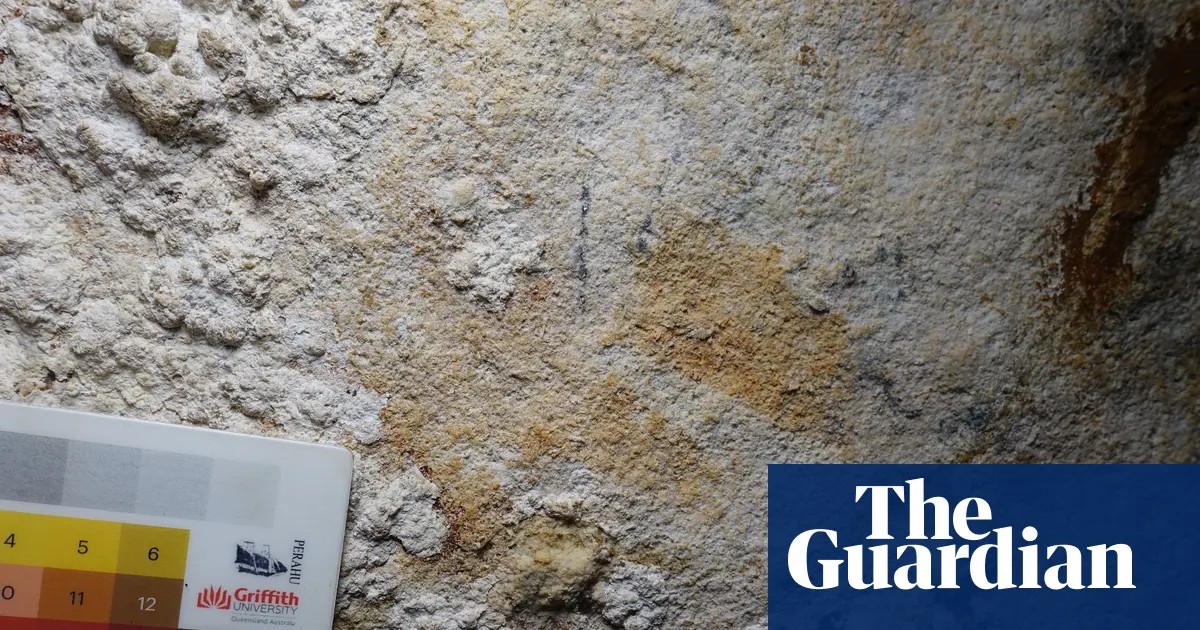
Archaeologists have discovered what may be the oldest known example of rock art – a faded hand stencil in a limestone cave on Muna Island, Indonesia. The artwork is estimated to be at least 67,800 years old, pushing back the timeline of human creative expression and offering new insights into early human migration patterns.
The Discovery and Its Significance
The hand stencil was found in Liang Metanduno, a cave already known for its prehistoric paintings, but overlooked amidst newer depictions of animals and figures. Dating the art proved challenging, but scientists were able to determine a minimum age by analyzing calcite deposits that had formed over the stencil. This discovery matters because it provides a concrete timeframe for the development of symbolic thought and artistic expression in early humans.
The dating of this artwork also sheds light on the early settlement of Australia. The stencil likely predates the arrival of modern humans in Sahul, the landmass that once connected Australia, New Guinea, and Tasmania. This supports the theory that some human ancestors migrated north through Sulawesi before eventually reaching Australia.
How the Art Was Made and What It Means
The stencil was created using a simple but effective technique: spraying ochre-mixed water over a hand pressed against the cave wall. Interestingly, the stencil depicts unusually long, pointy fingers. Researchers speculate this may have been intentional, possibly holding symbolic meaning relating to animal claws or mythical creatures.
“Whether they resemble animal claws or more fancifully some human-animal creature that doesn’t exist, we don’t know, but there’s some sort of symbolic meaning behind them.” – Prof. Adam Brumm, Griffith University.
The question of who created the art is open for debate. While the researchers suggest it was likely Homo sapiens, they acknowledge that other hominin species, like Neanderthals or the elusive Denisovans, cannot be ruled out. Similar hand stencils found in Spanish caves have been attributed to Neanderthals, blurring the lines of what cognitive capabilities early humans possessed.
Debate and Remaining Questions
Some experts, like Prof. Paul Pettitt of Durham University, caution against over-interpreting the artwork. The pointy fingers may be accidental rather than intentional, and attributing complex thought to the stencil is premature. He emphasizes that Neanderthals also modified hand stencils, so the ability to create such art isn’t exclusive to Homo sapiens.
This debate highlights the difficulty in understanding the minds of our ancient ancestors. Did they think symbolically, or was their art simply a result of experimentation? The discovery prompts us to reconsider what we know about early human cognition and the diverse capabilities of different hominin species.
The hand stencil in Indonesia is more than just a piece of ancient art; it’s a window into the past that raises fundamental questions about human origins, migration, and the evolution of creative expression. It underscores how much we still have to learn about our earliest ancestors.