



New fossil discoveries reveal the earliest vertebrates – primitive jawless fish from the Cambrian period (around 518 million years ago) – possessed not two, but four fully functional, camera-like eyes. The groundbreaking research, led by paleontologists at Yunnan University in China, sheds light on how early vertebrates evolved vision and how the brain’s pineal gland transformed over millions of years.
The Cambrian Predatory Arms Race
The Cambrian period was a time of rapid evolutionary experimentation. Animals were developing new body plans and senses in direct response to escalating predation pressures. These myllokunmingiid fish, among the earliest known vertebrates, lived in precisely this dangerous environment. Their survival depended on heightened awareness, and it appears they achieved this through an unusual visual setup.
Four Eyes: A Wider View in a Dangerous World
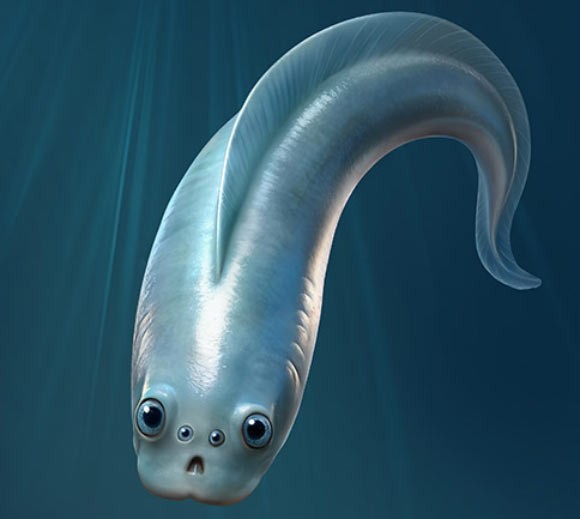
The newly examined fossils, preserved in the Chengjiang fossil beds of southern China, show two large lateral (side-facing) eyes – similar to modern vertebrates – alongside two smaller, centrally positioned eyes. This configuration likely provided a wider field of vision, crucial for spotting predators in the chaotic Cambrian seas.
“Seeing that was incredibly exciting,” said Professor Peiyun Cong of Yunnan University. “We started by examining the obvious large eyes to understand their anatomy — and it was a complete surprise to find two smaller, fully functional eyes between them.”
The Pineal Gland: From Image-Former to Sleep Regulator
The central eyes aren’t just primitive leftovers. Researchers found evidence that these structures were once fully developed, image-forming eyes. Modern vertebrates retain a vestigial version of this setup in the pineal gland, a brain structure now primarily responsible for regulating sleep cycles through light-sensitive melatonin production.
The discovery suggests the pineal gland didn’t start as a simple light sensor, but rather as a sophisticated visual organ that gradually lost its imaging capabilities over time. This evolutionary shift explains why some modern fish, amphibians, and reptiles still have a “third eye” capable of detecting light.
Evidence in the Fossils: Melanin and Lenses
The team confirmed the eyes’ functionality through high-powered microscopy. They identified melanosomes – pigment-containing organelles essential for light absorption in living eyes – within all four eyes of the fossils. Chemical analysis verified the presence of melanin, the same light-sensitive pigment used in modern vertebrate vision. Circular structures within the eyes indicate they were capable of forming images, not just detecting light.
“Fossil eyes are incredibly rare,” said Professor Sarah Gabbott of the University of Leicester. “Yet under the right conditions they can, and when they do, they open a rare window into how extinct animals saw and experienced their world.”
A Shift in Understanding Vertebrate Evolution
The discovery reshapes our understanding of early vertebrate vision. Instead of assuming a gradual development of two-eyed sight, these fossils reveal that the ancestors of modern vertebrates were visually sophisticated animals. Their eyes weren’t just about survival; they were about navigating a dangerous world with an advantage.
“This changes how we think about the early evolution of vertebrates,” said Dr. Jakob Vinther of the University of Bristol. “It turns out our ancestors were visually sophisticated animals navigating a dangerous world.”
The research, published January 21, 2026 in Nature, underscores the remarkable adaptability of early life and provides a compelling glimpse into a world where four eyes were the norm.
In essence, this discovery reminds us that evolution rarely follows a straight line. Sometimes, the path to modern complexity involves unexpected detours, such as the temporary existence of a fourth eye in our distant ancestors.