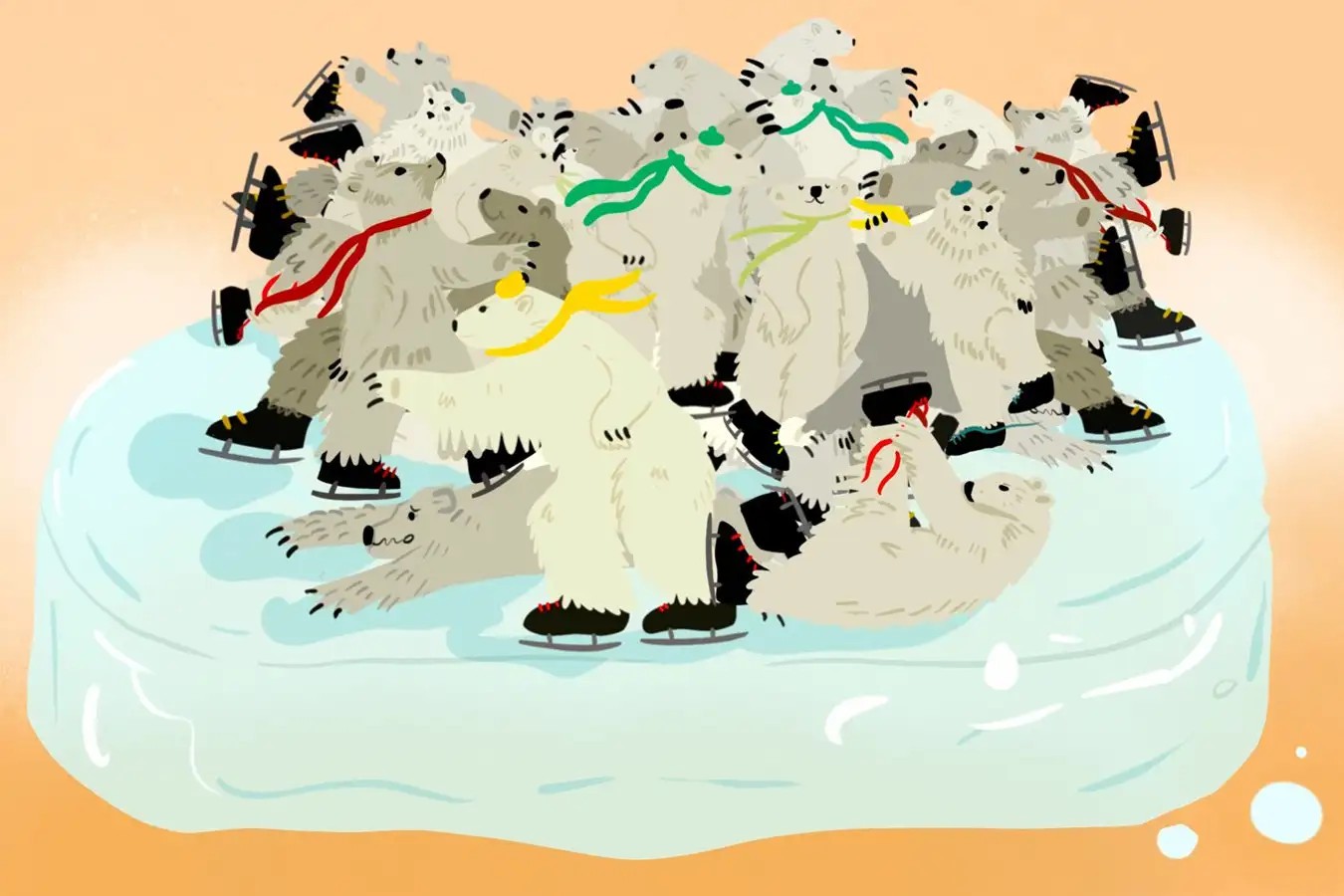
Canada’s National Capital Commission (NCC) uses an unusual metric for describing snowfall amounts: polar bears. According to the NCC, every centimeter of snow on Ottawa’s Rideau Canal—the world’s largest skating rink—requires crews to remove 125,000 kilograms of snow, which is roughly equivalent to 450 polar bears.
This unconventional unit of measurement raises a simple question: why? The answer is that most people have no intuitive sense of what 125,000 kilograms of snow feels like. Polar bears, despite being absent from the Ottawa region, provide a visceral, if absurd, comparison point.
The Math Behind the Bears
The average polar bear weighs around 278 kilograms (612 pounds), but this varies significantly by sex. Males can reach 600 kilograms (1,300 pounds), while females average around 150-290 kilograms (330-650 pounds). Depending on the gender mix, the NCC’s snow removal efforts could be equivalent to either a large group of female bears or a smaller number of males.
This illustrates a broader problem with informal measurements: lack of precision. Many people casually use terms like “a shedload” to describe quantities without clear definition. One reader questioned the size of the “shed” used in such comparisons, highlighting the need for standardized units—even if those units are intentionally strange.
The Science of Annoying Sounds
Beyond odd measurements, researchers recently explored the physics of peeling adhesive tape. High-speed cameras revealed that the screeching sound occurs when micro-cracks travel through the tape at supersonic speeds, creating a shockwave. The study suggests understanding the phenomenon may lead to quieter peeling methods, though the practical application remains unclear.
Retracted Research and Questionable Conclusions
Finally, a retracted study on ivermectin and liver cancer provides an example of scientific misconduct. The paper, originally published in 2022, was pulled after the journal discovered image duplication and revealed the lead author had not approved the final manuscript. Despite these issues, the authors claimed the study’s conclusions were “otherwise unaffected,” a statement that defies logic given the severe methodological flaws.
The absurdity of measuring snow in polar bears, the physics of irritating sounds, and retracted research all underscore a simple truth: human perception is often unreliable, and even scientific rigor can be undermined by poor practices.
The use of polar bears as a measurement unit is a playful reminder that context and clarity are essential—even when dealing with seemingly straightforward data.