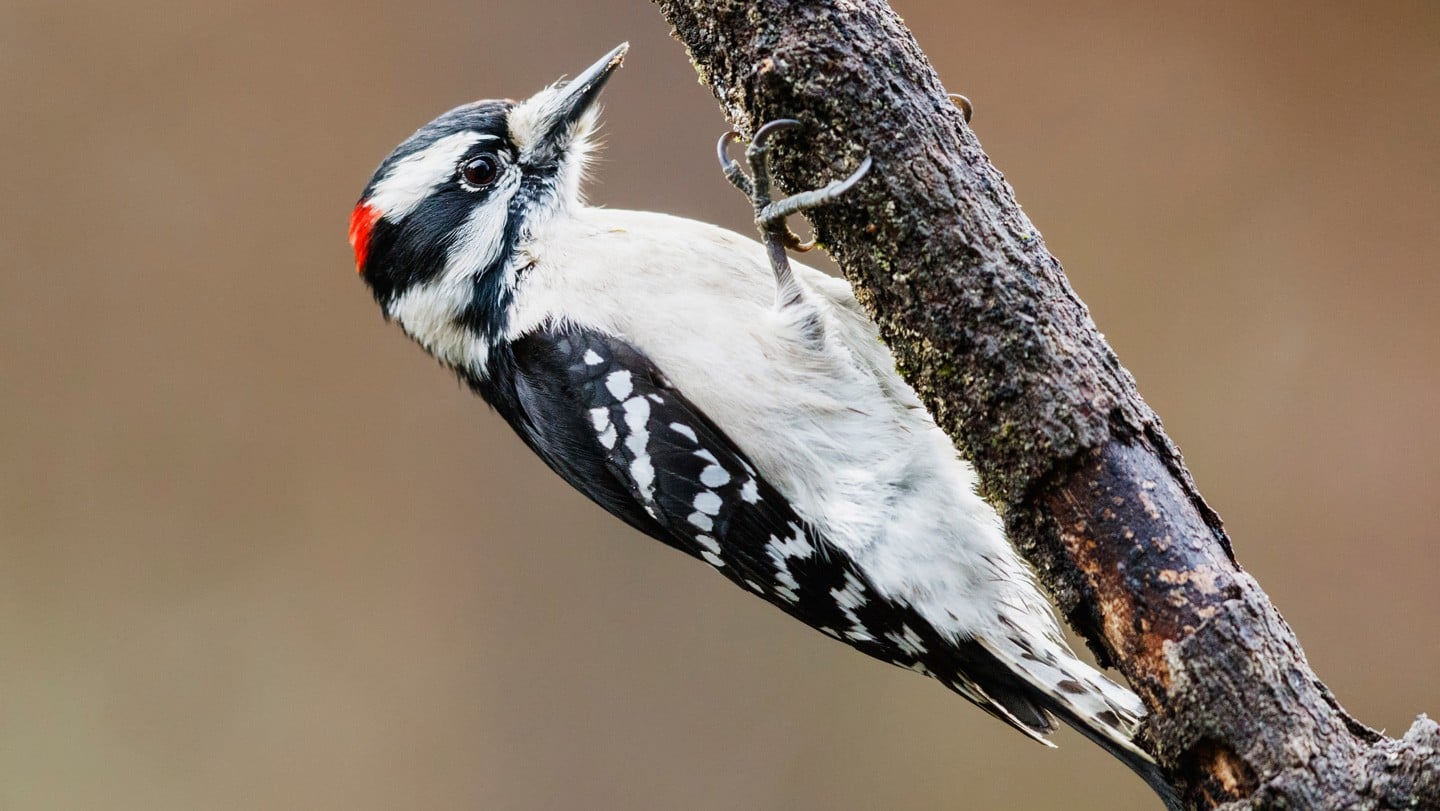

Woodpeckers don’t just hammer at trees; they grunt with each strike, much like a tennis player exhaling during a powerful swing. New research published in the Journal of Experimental Biology reveals that these grunts aren’t random – they’re a crucial part of how woodpeckers achieve their astonishingly fast and forceful pecking. The study sheds light on the biomechanics of this behavior, moving beyond previous research focused solely on head impact protection.
The Mechanics of a Rapid Hammer
Pecking appears simple, but it’s a complex feat requiring synchronized muscle movements. Researchers at Brown University captured eight wild downy woodpeckers and used electrodes to monitor muscle activity while simultaneously recording high-speed video. The data revealed that woodpeckers stiffen neck muscles similarly to humans using a hammer, reducing energy loss during impact.
- Tail muscles stabilize the body before each strike, while a single hip muscle generates the force.
- Head and neck muscles overlap contractions, smoothing out the rapid, back-and-forth motion.
Breathing in Sync with the Beat
What truly sets woodpeckers apart is their breathing pattern. Instead of holding their breath like weightlifters, they exhale with each peck, mirroring tennis players. They can deliver up to 13 strikes per second, taking mere 40 milliseconds to inhale between each blow – faster than a human blink. This rhythmic breathing isn’t just incidental; it’s synchronized with muscle movements, enhancing coordination.
Beyond Drilling: Communication Through Rhythm?
The study suggests that this coordinated breathing might indicate a deeper connection between pecking and communication. Songbirds take mini-breaths while singing, implying that woodpecker drumming could be a form of non-vocal expression. This challenges the traditional view of pecking as purely a functional behavior, opening new avenues for studying animal communication.
The discovery underscores the surprising parallels between human and avian biomechanics, highlighting how seemingly distinct species can evolve similar strategies to overcome physical challenges. Understanding these mechanisms could offer insights into muscle coordination, impact absorption, and the evolution of communication in both birds and humans.