
New research from Kiel University in Germany confirms that female giant rainforest mantises (Hierodula majuscula ) develop significantly more powerful predatory strikes than males, a difference that emerges during maturation. This finding clarifies how and when the sexes diverge in strike force, challenging previous assumptions about scaling in insect biomechanics.
The Growth of Power: From Nymph to Hunter
The study tracked the strike force of mantises from early development through adulthood, revealing a clear pattern: young mantises, regardless of sex, have weak strikes. However, as they grow through multiple molts (six for males, seven for females), females rapidly outpace males in striking power. Adult females can deliver strikes with approximately 196 millinewtons of force, nearly three times the 70 millinewtons generated by adult males.
This isn’t just a matter of size. While the mantis’s overall weight scales predictably with its growth, the increase in strike force exceeds expectations based on muscle cross-sectional area alone. Researchers, led by entomologist Thies Büscher, are now investigating how females achieve this disproportionate strength.
Ambush Predators: How Mantises Hunt
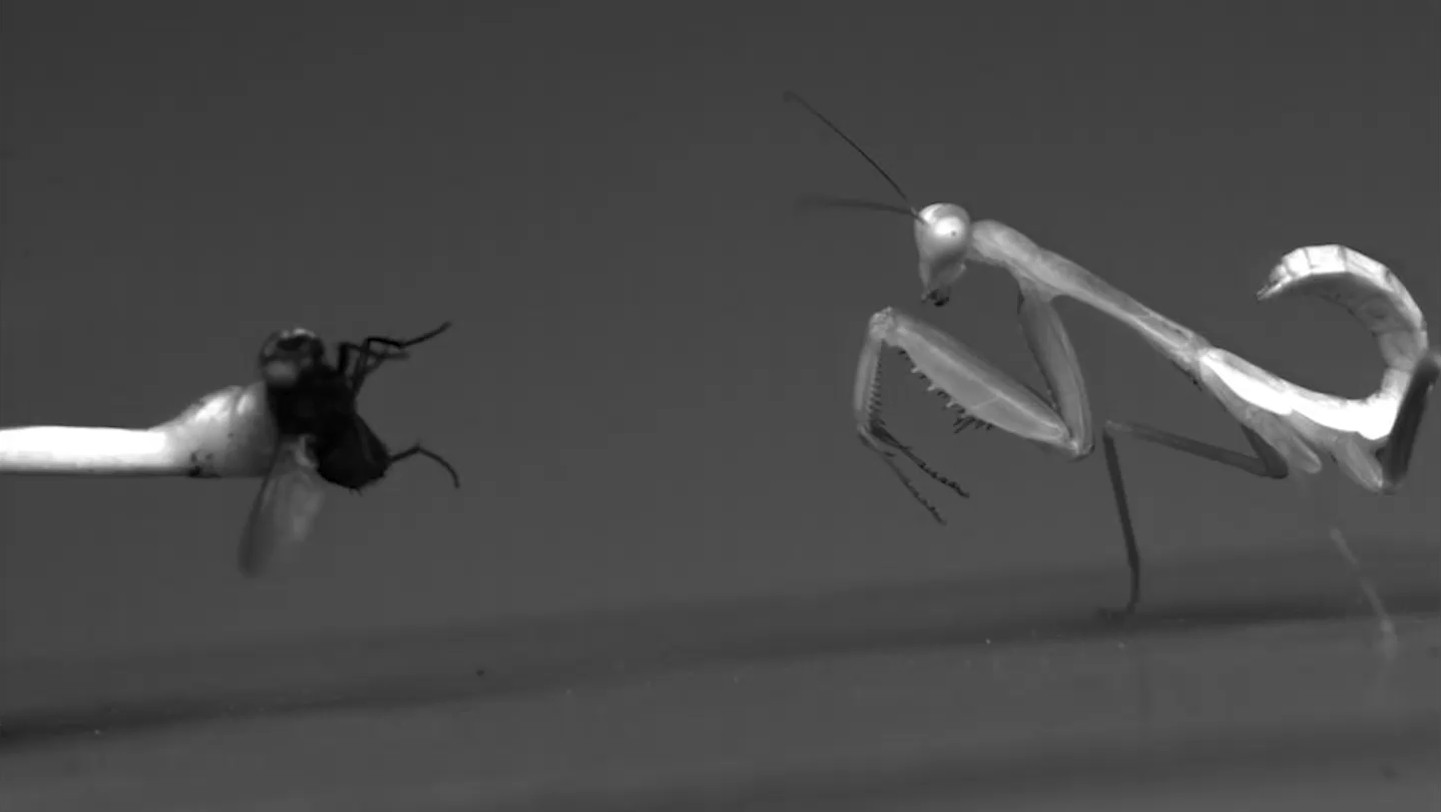
These mantises, native to Australia, are ambush predators. They remain motionless until prey enters striking range, then unleash a rapid attack using specialized raptorial legs. The strike isn’t venomous, but the mantis’s sharp mouthparts inflict severe injuries, causing rapid fluid loss in the captured prey.
To measure strike force, researchers presented hungry mantises with fly larvae inside a transparent box connected to a force-measuring instrument. The results were consistent: females consistently hit harder than males. The difference matters because it reflects the evolutionary pressures shaping predatory behavior in these insects.
The Mystery of Extra Power
The fact that female mantises strike harder than predicted by muscle size alone raises questions about biomechanical efficiency. Some animals store energy in spring-like mechanisms, releasing it for rapid attacks, but no such mechanism has yet been identified in mantises. This suggests either a previously unknown anatomical feature contributes to female strike power or that current biomechanical models are incomplete.
The discrepancy between muscle size and strike force underscores how little we still understand about the biomechanics of insect predators. Further research is needed to pinpoint the anatomical and physiological mechanisms responsible for this disparity.
Ultimately, this study confirms that predatory force in Hierodula majuscula is not simply a matter of size but a complex interaction of growth, sex, and biomechanical adaptation. The hunt for answers continues.