



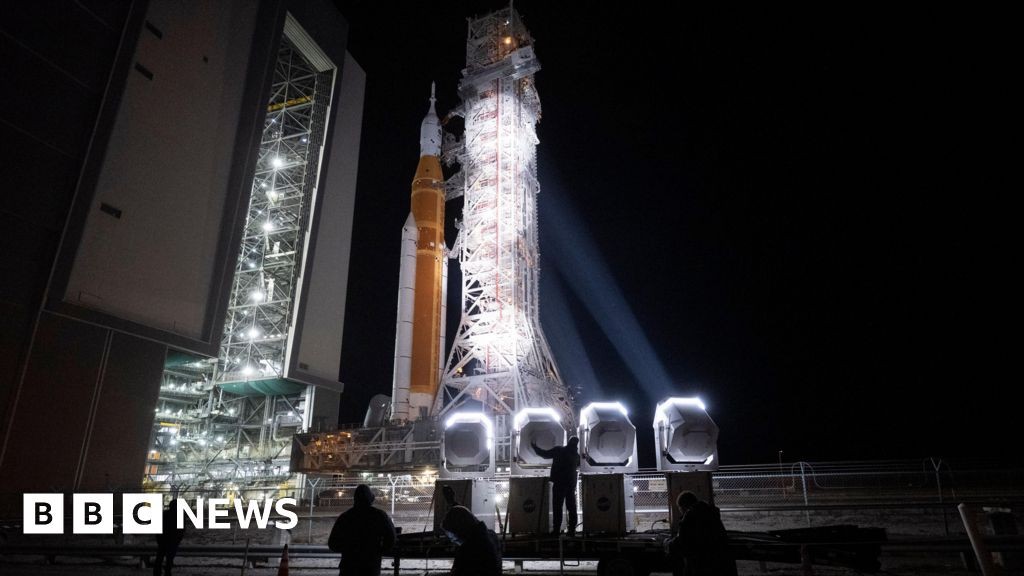
NASA’s colossal Space Launch System (SLS) rocket has once again been moved to its launchpad, signaling a renewed effort to send astronauts on a lunar flyby mission—a feat humanity hasn’t attempted in over half a century. The move follows a delay in March caused by a fault in the rocket’s helium system, which required repairs at NASA’s Vehicle Assembly Building (VAB).
Repair and Re-Positioning
Engineers have since addressed the helium issue, and are now conducting final tests at the pad to confirm the rocket’s readiness for a launch window opening in early April. The SLS, standing nearly 100 meters tall and weighing approximately 5,000 tons, was transported via Crawler-Transporter 2, a massive tracked vehicle built in 1965 for the Saturn V missions. The four-mile journey to the launch pad, completed at a deliberate pace of around 1.6 kilometers per hour, took up to 12 hours.
This slow, careful movement isn’t accidental; it’s designed to minimize stress on the multi-billion-dollar rocket and tower. The gradual pace also allows teams to identify and correct any unexpected shifts during transport. The Artemis II crew – Reid Wiseman, Victor Glover, Christina Koch, and Jeremy Hansen – have already entered pre-flight quarantine, ready to travel to Florida closer to launch for final rehearsals.
System Checks and Launch Dates
At the pad, engineers will verify the repairs made in the VAB, ensuring no components shifted during transit. They will reconnect the launch tower, conduct pressure tests on the helium system, and run simulated countdowns without fueling the tanks. NASA’s mission management team will review the data days before the earliest launch opportunity on April 1st to determine whether to proceed.
The mission itself will be a ten-day journey looping around the far side of the Moon before returning to Earth. NASA is targeting an 18:24 EDT launch on April 1st (23:24 in the UK), with backup windows available through April 6th, and a final opportunity on April 30th.
Why This Matters
The Artemis program is critical because it represents a deliberate return to crewed deep-space exploration. The earlier helium leak highlights the inherent risks of complex rocket systems and the importance of rigorous testing. This isn’t just about reaching the Moon again; it’s about establishing a sustainable presence there, paving the way for future missions like Artemis III (2027) and Artemis IV (2028), which aim to land astronauts on the lunar surface.
The Artemis II mission is a necessary step toward long-term lunar exploration, proving that NASA can reliably send humans beyond Earth orbit.
The program’s success is also vital for the growing commercial space sector, proving that government-led initiatives can still drive innovation and inspire private investment in space technologies.