




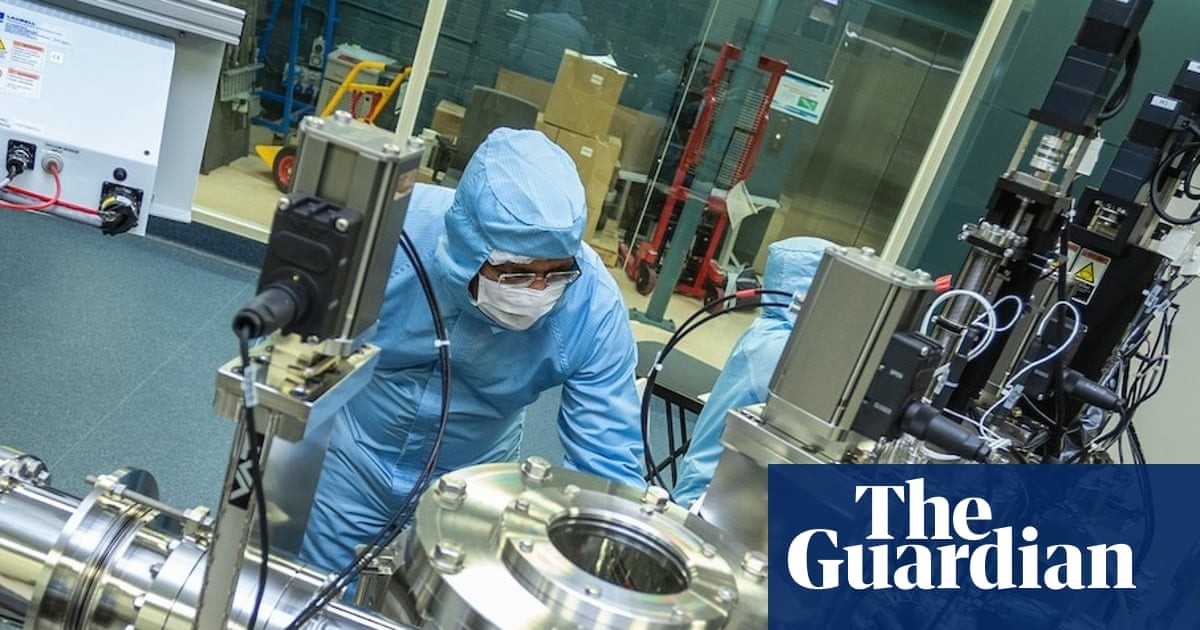
Australian researchers have created the first working prototype of a quantum battery, marking a significant step toward potentially revolutionizing energy storage. Unlike conventional batteries, which face increasing charge times as their capacity grows, quantum batteries exhibit the counterintuitive property of charging faster as they get larger. This breakthrough, detailed in the journal Light: Science & Applications, demonstrates the feasibility of a technology first theorized in 2013.
The Promise of Quantum Efficiency
The core principle behind quantum batteries lies in quantum mechanics. Specifically, a phenomenon called “collective effects” allows multiple quantum cells to charge more rapidly when working together. In a standard lithium-ion battery, doubling the size almost doubles the charging time. In contrast, scaling up a quantum battery should reduce the charge time proportionally.
The current prototype, charged wirelessly using a laser, achieves full charge-discharge cycles. Dr. James Quach, lead researcher at CSIRO, explains that while the prototype’s storage time is currently measured in nanoseconds, the theoretical potential is immense: “For a battery that takes one minute to charge, six orders of magnitude would mean it would stay charged for a couple of years.”
Current Limitations and Future Applications
Despite this progress, the prototype’s energy capacity remains minimal. The current storage capability is measured in only a few billion electron volts – far too little to power real-world devices. The immediate focus is increasing storage duration beyond the current nanosecond range.
However, the implications are far-reaching. Fully functional quantum batteries could dramatically accelerate charging times for electric vehicles, potentially allowing for “on-the-go” wireless charging from drones or roadside infrastructure. More immediately, the technology is expected to benefit quantum computers, which require coherent energy delivery with minimal loss.
“The first place that it’ll have an impact is actually for quantum computers,” notes Prof. Andrew White of the University of Queensland, who was not involved in the research.
A Working Prototype, Not Immediate Mass Adoption
While widespread consumer application is still years away, this prototype solidifies quantum batteries as more than just a theoretical concept. The challenge now is scaling the energy capacity and extending storage duration. As Dr. Quach concludes, “What we need to do next is… to increase the storage time.”
The success of this prototype paves the way for ongoing research into materials science, laser-based charging systems, and quantum cell optimization. Quantum batteries may not replace traditional power sources overnight, but they represent a fundamental shift in how we approach energy storage.