



A dormant supermassive black hole at the heart of galaxy J1007+3540 has violently reactivated, erupting in a cosmic display spanning an astonishing 1 million light-years. The event, observed by astronomers using radio telescopes in India and the Netherlands, reveals a black hole that has been quiet for roughly 100 million years suddenly blasting out jets of energy and plasma. This phenomenon provides a rare look at how these galactic engines can switch on and off over vast timescales.
The Anatomy of a Cosmic Outburst
The supermassive black hole resides within an exceptionally dense galaxy cluster, where it competes with the surrounding gravitational forces. As matter spirals into the black hole through an accretion disk, intense magnetic fields channel charged particles into powerful jets emitted from the poles at near-light speed. The jets, glowing brightly across the radio spectrum, define these regions as Active Galactic Nuclei (AGNs).
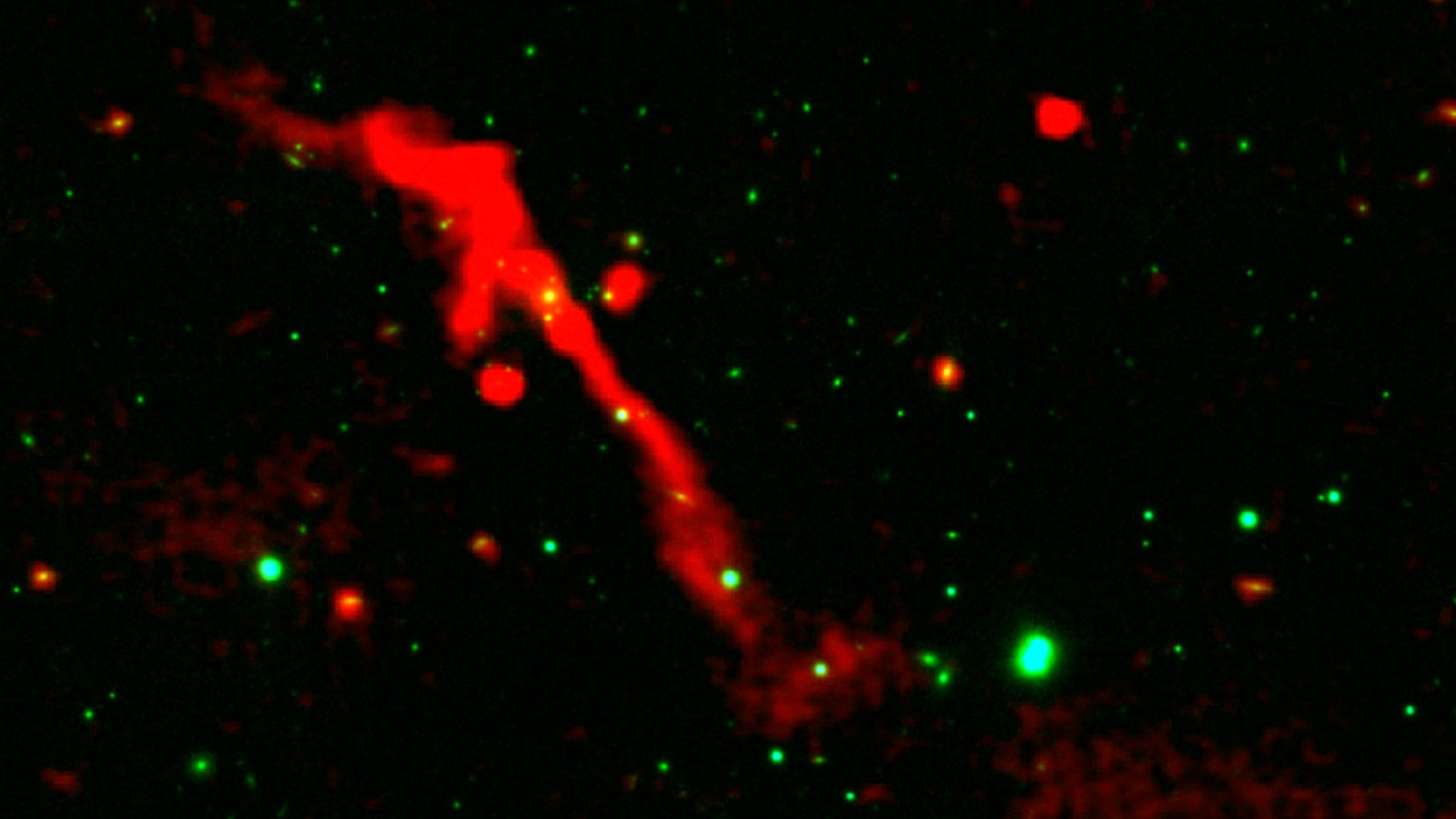
What sets J1007+3540 apart is its history of repeated shutdowns and restarts. The observed structure shows a bright, active inner jet encased within a fainter outer cocoon of older plasma – the remnants of previous outbursts. This layering confirms the black hole’s episodic behavior, where it cycles between periods of intense activity and long stretches of dormancy.
Galactic Clusters Shape Eruptions
The extreme environment of J1007+3540—a dense cluster filled with scorching hot gas—significantly distorts the jets. The surrounding pressure compresses and bends the plasma, creating a visible asymmetry: the northern lobe appears squashed, while a faint tail stretches southwest, trailing plasma dragged through the cluster over millions of years.
This interaction between the jet and the surrounding gas demonstrates how galactic clusters can sculpt the structures of AGNs. The older particles within the compressed lobe have lost energy, indicating they were ejected long ago and are now being subdued by the external pressure.
Why This Matters
Supermassive black holes are central to galaxy evolution, and their activity influences the growth of their host galaxies. J1007+3540’s behavior is not an anomaly; many AGNs cycle between active and quiescent states. However, this galaxy’s clear interaction with its cluster offers a unique opportunity to study how external forces shape these energetic events. Understanding these dynamics can refine models of galactic growth and the broader cosmic landscape.
This observation reinforces that black holes aren’t always consistent engines of destruction; they can lie dormant for eons before flaring up again, sometimes dramatically altered by their environment.
The discovery provides astronomers with a clearer picture of how galaxies grow and evolve over billions of years.