


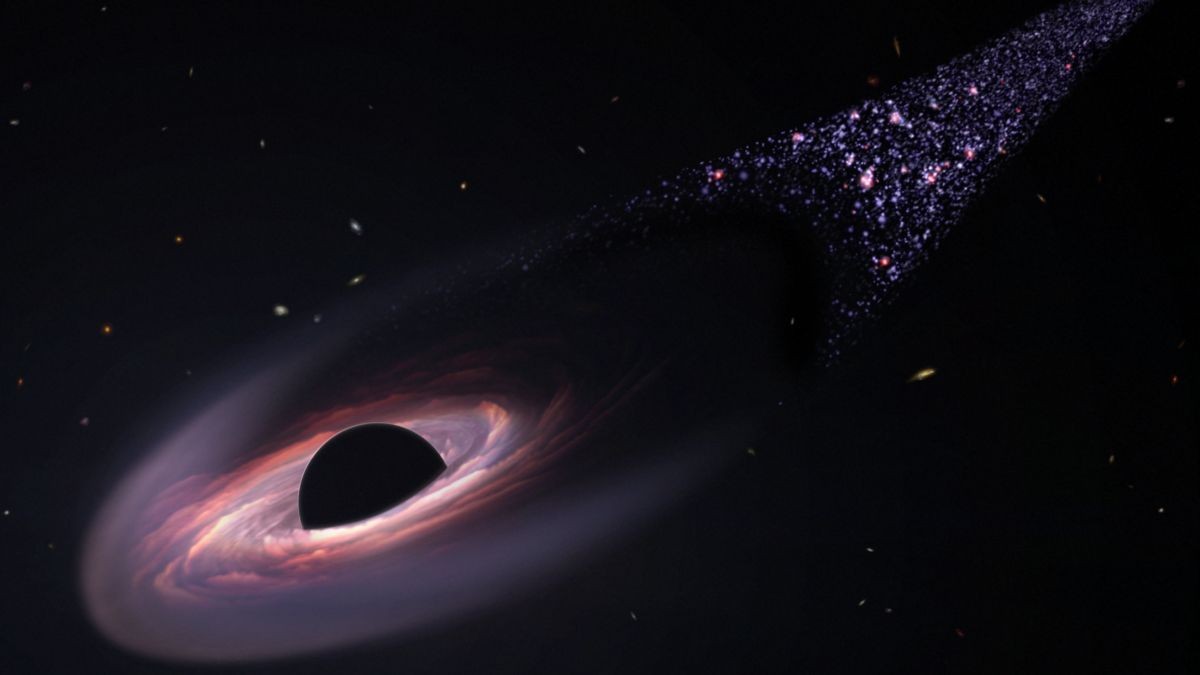
For decades, scientists theorized that supermassive black holes could be violently ejected from their host galaxies. Now, observations from the James Webb Space Telescope (JWST) have definitively confirmed the existence of such an object, named RBH-1. This black hole, at least 10 million times the mass of our Sun, is hurtling through space at approximately 954 kilometers per second – over one-third of the speed of light.
The Discovery of RBH-1
First identified in 2023, RBH-1 was initially suspected to be a runaway black hole based on its unusual trajectory and a massive bow shock forming ahead of it, with a star-forming trail stretching 200,000 light-years behind. Recent JWST observations, led by astrophysicist Pieter van Dokkum, have verified these early findings. The black hole is indeed speeding away from its parent galaxy, heading towards intergalactic space.
How Did This Happen?
The leading explanation is a gravitational kick resulting from a supermassive black hole merger. When two black holes collide, the asymmetrical release of energy can propel the resulting, larger black hole outwards at incredible speeds. Simulations and previous observations suggest these events are more common than once thought, and this confirms that they do happen.
Why this matters: This discovery provides direct evidence of a long-predicted phenomenon in astrophysics. It shows that black holes aren’t always anchored to galactic centers; they can be ejected into the void, potentially influencing the evolution of galaxies and the wider universe.
Measuring the Speed: The Bow Shock
Researchers used JWST’s NIRSpec instrument to analyze the velocity distribution within the bow shock—the compressed gas and dust in front of the black hole as it plows through the circumgalactic medium. The observed blueshift (compression of light towards shorter wavelengths) in front of the shock and redshift (stretching of light towards longer wavelengths) behind it revealed a dramatic velocity difference: material behind the shock is moving 600 kilometers per second faster than material in front. This structure can only be explained by a high-speed, massive object.
The Implications for Rogue Black Holes
This isn’t an isolated case. Evidence suggests there may be a significant number of rogue supermassive black holes wandering the universe, undetected and invisible in the darkness of intergalactic space. The confirmation of RBH-1 validates theoretical models and opens new avenues for studying these elusive objects.
“RBH-1 is empirical validation of the 50-year-old prediction that SMBHs can escape from their host galaxies,” according to the researchers.
The discovery of RBH-1 confirms that supermassive black holes can escape their galaxies through gravitational recoil or multi-body interactions. This provides a new piece of the puzzle in our understanding of how these massive objects shape the evolution of the universe.