

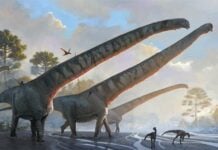

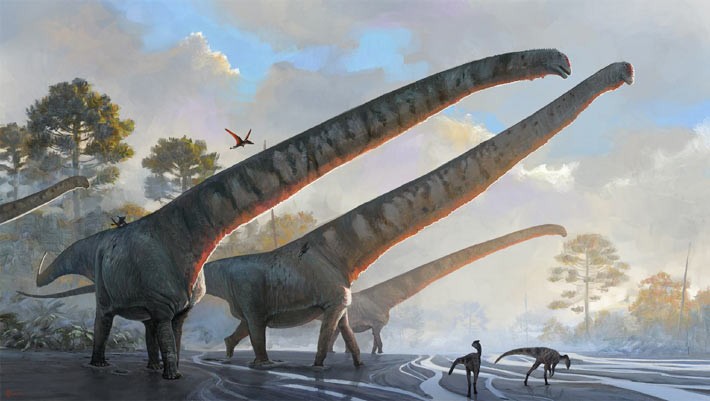
Paleontologists have identified a previously unknown species of Mamenchisaurus, a long-necked sauropod dinosaur, from fossils discovered in southwest China. The dinosaur, named Mamenchisaurus sanjiangensis, lived approximately 160 million years ago during the Early Oxfordian age of the Late Jurassic period. This discovery adds to our understanding of sauropod evolution in East Asia.
The Discovery
The partial skeleton of M. sanjiangensis was excavated from the Shaximiao Formation in Chongqing, China. The fossils were embedded in purplish-red mudstone, a common sedimentary environment for preserving Jurassic dinosaur remains.
According to Dr. Hui Dai and colleagues from the Chongqing Institute of Paleontology, this species is closely related to other Mamenchisaurus dinosaurs. However, its existence highlights the high diversity of sauropods during the Late Jurassic. These dinosaurs were not uniformly distributed around the globe; Asian faunas, in particular, featured distinct lineages not seen in Europe or the Americas.
Why This Matters
The abundance of mamenchisaurids in Late Jurassic deposits in China suggests that East Asia was a critical region for sauropod evolution. This raises questions about how isolated this landmass was from other continents like Laurasia and Gondwana during that time.
“A refined understanding of the evolutionary relationships of Middle-Late Jurassic Chinese eusauropods is pertinent to testing hypotheses concerning the isolation of East Asia from western Laurasia and Gondwana at this time and the paleobiogeographical history of early branching sauropods and eusauropods more broadly.”
The exact age of the Shaximiao Formation remains debated, but the presence of M. sanjiangensis reinforces the idea that this area was a hotspot for sauropod diversification near the Middle-Late Jurassic transition period.
Gaps in Knowledge
While this discovery provides valuable insights, paleontologists acknowledge that gaps remain in our understanding of sauropod evolution in East Asia. Further examination of existing specimens is needed to resolve uncertainties and fill in missing pieces of the evolutionary puzzle. The researchers emphasize that more work is necessary to refine the relationships between Chinese eusauropods and their counterparts from other regions.
The study was published in Scientific Reports on November 25, 2025 (doi: 10.1038/s41598-025-29995-z). The discovery of Mamenchisaurus sanjiangensis underscores the importance of continued paleontological research in China, as it is likely to reveal even more details about the history of these magnificent creatures.