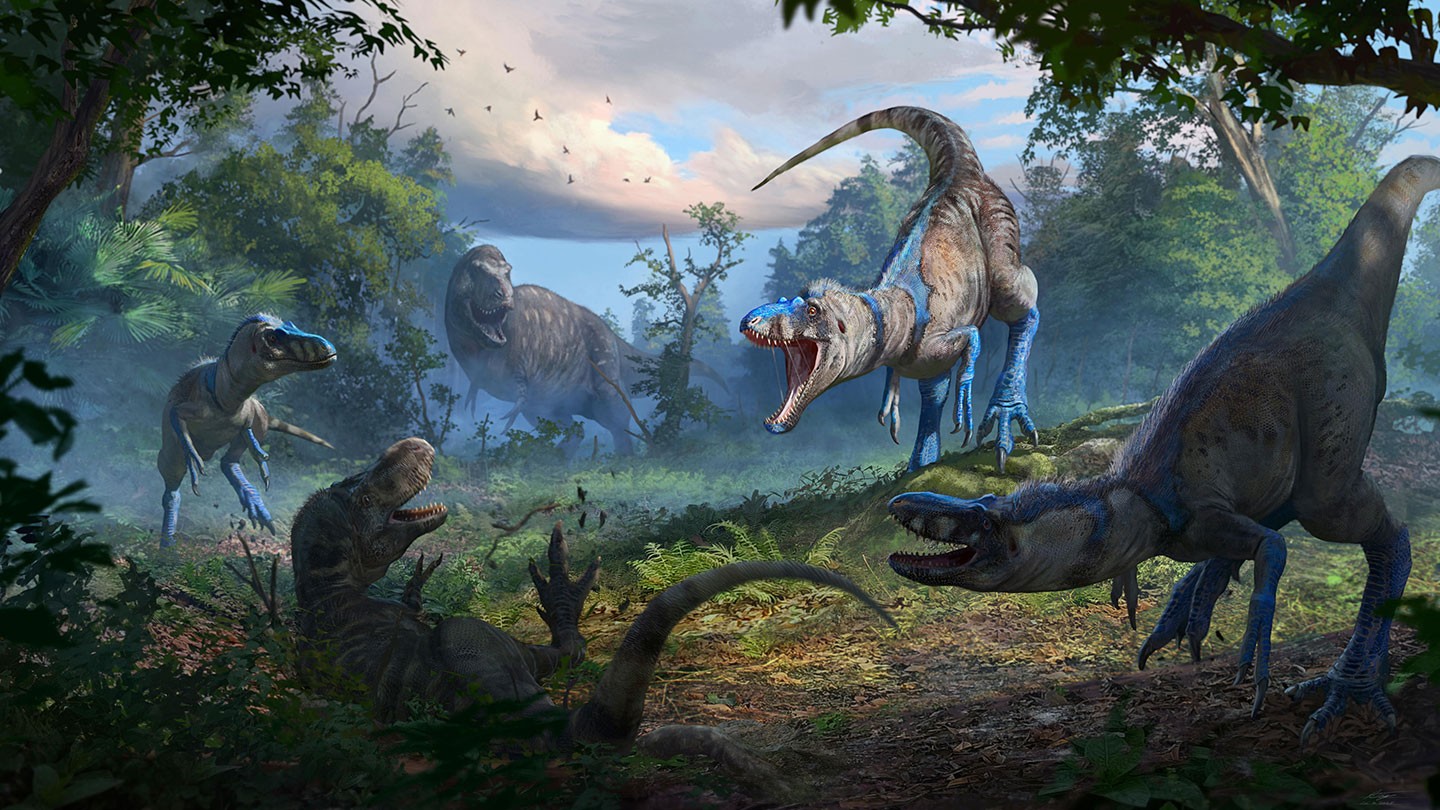
For over three decades, paleontologists have debated the identity of a smaller tyrannosaur fossil: was it a juvenile Tyrannosaurus rex, or a distinct species? New research conclusively confirms the latter. Two independent studies, published in Nature and Science, demonstrate that this dinosaur was not a young T. rex but an adult Nanotyrannus lancensis – a long-sought missing link in tyrannosaur evolution.
The Decades-Long Debate
The controversy began in 1942 with the discovery of a small, sharp-toothed skull initially classified as Gorgosaurus. In 1988, scientists reclassified it as Nanotyrannus lancensis, a “pygmy” tyrannosaur. Skeptics argued the fossils represented juvenile T. rex, given similarities in skull structure. The lack of complete skeletal evidence left the debate unresolved for years.
Proof in the Bones
Lindsay Zanno of North Carolina State University and James Napoli of Stony Brook University led the first conclusive study. They analyzed a remarkably preserved skeleton unearthed in Montana’s 67-million-year-old Hell Creek Formation. The fossil, part of the famous “Dueling Dinosaurs” specimen, showed a small tyrannosaur locked in a struggle with prey.
The team found definitive evidence: growth rings in leg and arm bones indicated the dinosaur was fully grown, not a juvenile. Crucially, the tail contained 35 vertebrae – fewer than the 40 typical of adult T. rex – and the arms were proportionally larger. These distinctions, combined with unique features in the respiratory system and braincase, proved Nanotyrannus was a separate species.
Second Study Confirms Findings
A separate research team led by Christopher Griffin at Princeton University reached the same conclusion using a different fossil. They examined throat bones (the hyoid) which, like limb bones, show yearly growth rings. Their analysis confirmed the specimen was an adult N. lancensis.
“We converged on the same ultimate conclusion,” Griffin stated. “Two very different lines of evidence led us to the same result.”
A New Species, and Maybe Another
Researchers re-examined another long-debated fossil known as “Jane.” Analysis suggests Jane was a young Nanotyrannus, but slightly larger than N. lancensis. The scientists propose Jane represents a new species, Nanotyrannus lethaeus, named after the river Lethe in Greek mythology, which induced forgetfulness. The name alludes to the fact that the dinosaur has been hiding in plain sight for decades.
Ecological Roles and Implications
The confirmation of Nanotyrannus adds to growing evidence that dinosaur ecosystems remained diverse until the asteroid impact 66 million years ago. Nanotyrannus occupied a distinct ecological niche: it was smaller, faster, and had larger arms than the massive, bone-crushing T. rex. This suggests tyrannosaurs weren’t monolithic predators, but occupied varied roles within their environment.
The discovery also challenges decades of research on T. rex. Much of our understanding of tyrannosaur growth, movement, and diet may be based on data from two different dinosaurs. Existing research now requires reevaluation.
What’s Next?
A potential juvenile T. rex fossil is currently being prepared in Colorado, which could help refine our understanding of the species’ growth stages. For now, the confirmation of Nanotyrannus throws a wrench into our previous assumptions about tyrannosaur evolution, highlighting the ongoing dynamism of paleontological discovery.