



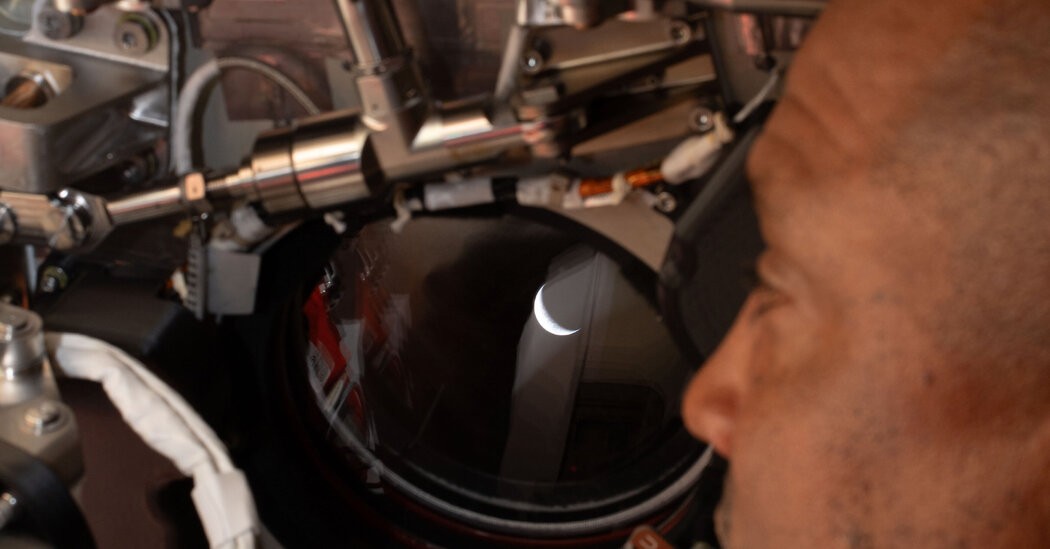
The Artemis II mission has officially entered a new era of human space exploration. On Monday, the four-person crew aboard the Orion spacecraft—Reid Wiseman, Victor Glover, Christina Koch, and Jeremy Hansen —surpassed the record for the farthest distance ever traveled by humans from Earth.
By clocking a distance of over 250,000 miles, the crew broke a 56-year-old record held by the Apollo 13 mission, which reached 248,655 miles in 1970. This milestone marks the first time humans have ventured this deep into space since the Apollo era ended in 1972.
The Lunar Flyby: A Journey into the Unknown
The mission is currently transitioning into its most critical phase: the lunar flyby. Unlike previous missions that focused on orbiting the side of the Moon visible from Earth, Artemis II is set to slip behind the lunar far side—a region characterized by a thicker crust, more intense cratering, and a much brighter, grayer appearance due to a lack of volcanic plains.
Key milestones for the upcoming hours include:
– 6:44 p.m. ET: The crew will enter a scheduled 41-minute radio blackout as the Moon physically blocks communication signals between the spacecraft and Mission Control.
– 7:02 p.m. ET: The Orion spacecraft will reach its closest approach to the lunar surface, passing at an altitude of approximately 4,070 miles.
– 7:07 p.m. ET: The crew will hit their maximum distance from Earth, reaching roughly 252,760 miles.
– 8:35 p.m. ET: As the crew begins their journey back toward Earth, they will experience a 53-minute solar eclipse, offering a rare opportunity to observe the solar corona from deep space.
Safety and Science: Navigating the Dark
While a communication blackout can sound daunting, NASA officials emphasize that it is a standard part of lunar trajectories. To ensure safety during this period of isolation, mission controllers have uploaded all necessary navigation data to the Orion spacecraft prior to the blackout.
Furthermore, the mission utilizes a “free return” trajectory. This engineering failsafe ensures that even in the event of an engine failure, the gravity of the Moon and Earth will naturally pull the spacecraft back toward our planet.
The scientific value of this flyby cannot be overstated. While robotic probes have photographed the far side, no human eyes have seen these landscapes in person for decades. The crew will be gathering geological data that will be vital for NASA’s future goal: landing humans on the lunar surface.
A Moment of Human Connection
Amidst the technical complexities of deep-space travel, the mission has also provided a deeply personal moment for the crew. In a solemn request to Mission Control, the astronauts asked to dedicate a lunar crater to Carroll Wiseman, the late wife of Mission Commander Reid Wiseman.
The dedication of “Carroll Crater” served as a poignant reminder of the human element behind the high-tech machinery. For Wiseman, the mission represents a fulfillment of a dream that was nearly sidelined by personal tragedy, now carried forward by the support of his daughters.
“We will continue our journey even further into space before Mother Earth succeeds in pulling us back to everything that we hold dear,” remarked mission specialist Jeremy Hansen, highlighting the dual nature of exploration: the drive to push boundaries and the profound connection to our home planet.
Conclusion
As the Artemis II crew moves behind the Moon, they are not just breaking distance records; they are paving the way for the next generation of lunar exploration. This mission serves as a bridge between the legendary Apollo era and a future where humanity may become a multi-world species.