



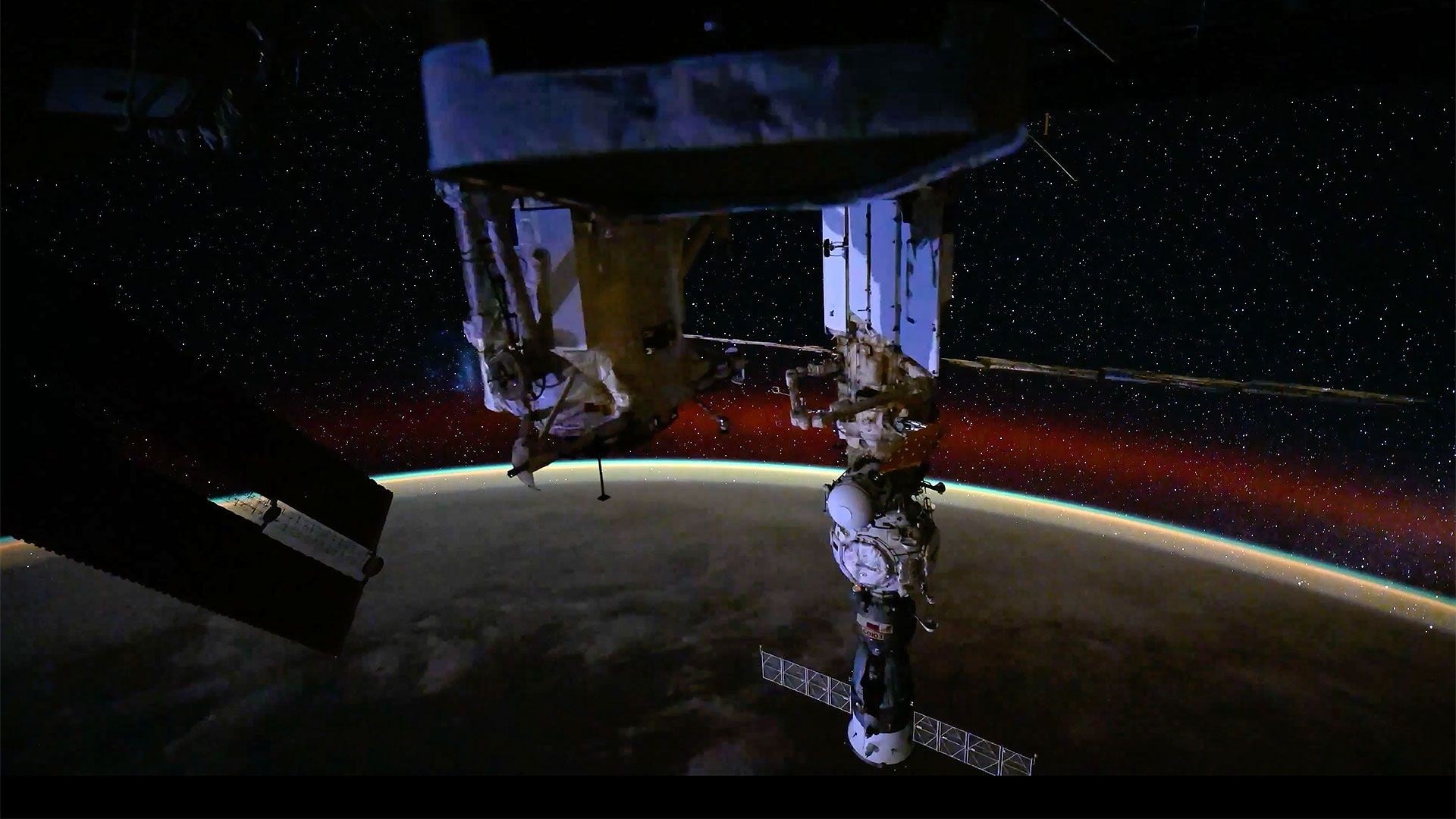
The International Space Station (ISS) welcomed a fresh team of astronauts this week, expanding its population to ten as of November 28, 2025. The Russian Soyuz MS-28 spacecraft docked successfully with the Rassvet module on Thursday, bringing NASA astronaut Chris Williams and Roscosmos cosmonauts Sergey Kud-Sverchkov and Sergei Mikaev aboard for an eight-month mission.
Crew Transition and Research
The arrival coincides with a period of heightened activity on the station. With ten crew members present during the handover, the ISS is operating at full capacity. Ongoing research includes studies on how the human body adapts to long-duration spaceflight. For example, Expedition 73 flight engineer Zena Cardman conducted a live ultrasound scan of Jonny Kim’s chest under the remote guidance of doctors on Earth, providing real-time data on cardiovascular changes in microgravity.
Another experiment, Droplet, utilized a fluorescence microscope to analyze particle behavior in fluids, which could lead to advancements in optical materials and pollution removal techniques. These experiments underscore the ISS’s role as a unique laboratory for scientific discovery.
Station Maintenance and Logistics
Maintaining the ISS requires constant attention. Expedition 73 commander Sergey Ryzhikov conducted pre-flight checks on the Soyuz MS-27 spacecraft, ensuring its readiness for the crew’s eventual return to Earth.
To accommodate the Soyuz MS-28 docking, the Cygnus XL cargo ship, the S.S. William C. “Willie” McCool, was temporarily moved away from the station using the Canadarm2 robotic arm. This logistical maneuver highlights the complex coordination required to operate and resupply the ISS.
Current ISS Configuration
As of Friday, November 28, the ISS hosts a total of ten crew members representing NASA, Roscosmos, and the Japan Aerospace Exploration Agency (JAXA). Three crew spacecraft are currently docked: SpaceX’s Dragon “Endeavour,” Roscosmos’ Soyuz MS-27, and the newly arrived Soyuz MS-28. Four additional cargo spacecraft – two Progress vessels, Cygnus XL, and HTV-X1 – are also attached to the station, ensuring a steady flow of supplies and equipment.
The ISS continues to function as a vital hub for international collaboration in space, pushing the boundaries of scientific research and human exploration. The seamless transition of crews and ongoing maintenance are critical for sustaining operations in this unique orbital environment.