Deep underground. That’s where the action is.
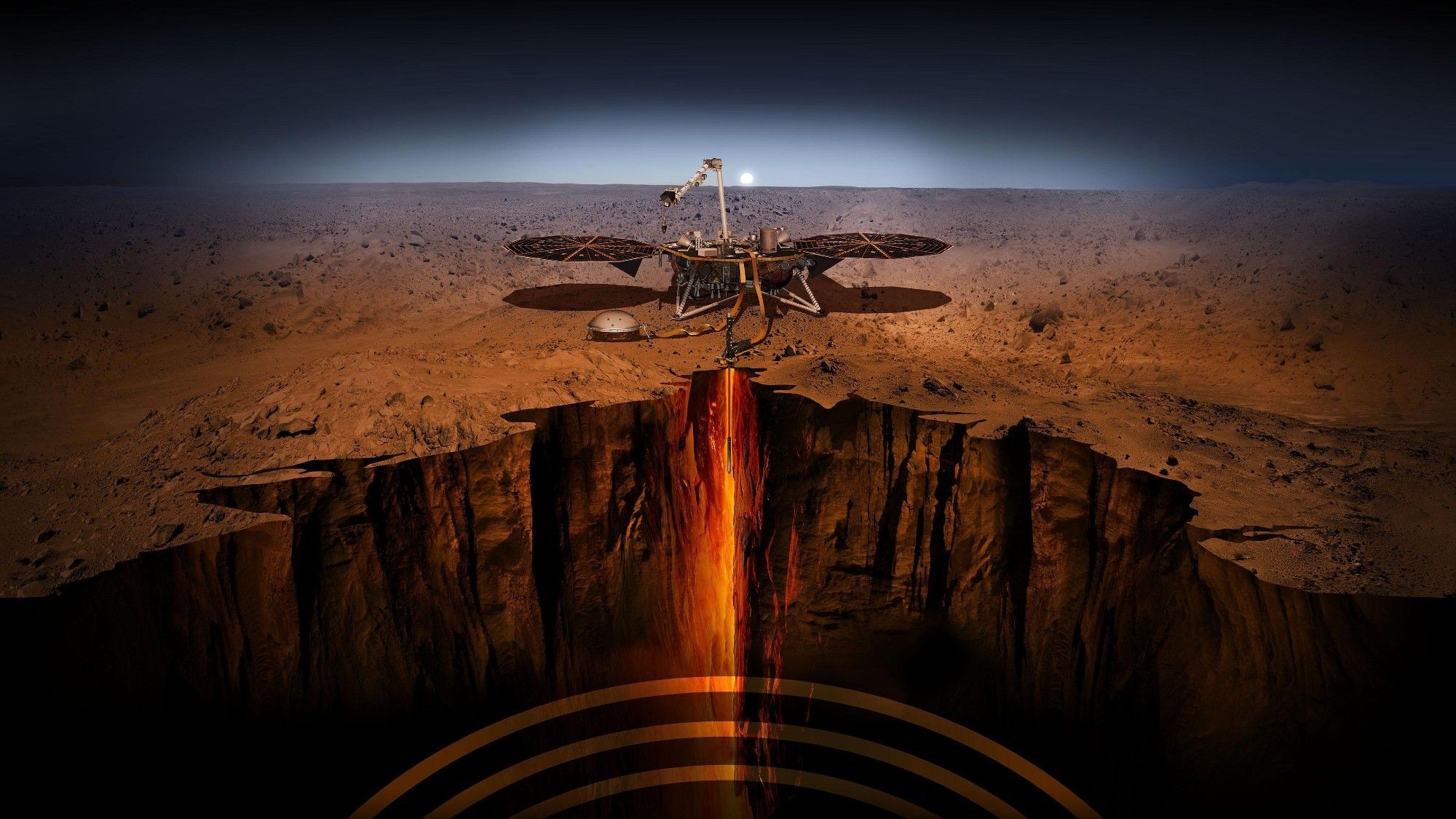
Seismic data from NASA’s InSight lander points to something wild. Massive seas of magma used to chug inside Mars’ crust. We are talking oceans of molten rock. They sloshed around billions of years ago.
This changes the playbook on Martian history. It forces us to rethink what we know. And it might change how we view life on other planets, too.
The seismic clue
InSight operated on Mars between 2018 and early 2022. Its main job was listening. Listening to the ground shake. Marsquakes happen from meteor strikes or internal shifts.
The lander detected tremors traveling at different speeds through different rocks. Speed tells us density. Density tells us composition.
Here is what they found. A clear boundary sitting 15 miles deep. Above that line lies thick mafic rock. Rich in iron and silica. Below it sits dense ultramafic rock. Crystalline. Depleted in silica. This heavier stuff stretches another 8 miles down to the mantle.
Two layers. Distinct. Separate.
How did they get there?
Simple physics doesn’t explain a split this clean. Unless…
The rocks were once liquid. Melted.
Oxford researchers ran geothermal models. The math checks out if the crust held enormous pockets of magma. Like oil separating from water in a jar, the heavy ultramafic sank. The lighter mafic stayed up top.
Then everything cooled. Frozen in place.
These weren’t just random puddles. They likely connected across hundreds of kilometers. Think of Olympus Mons or Tharsis not as isolated volcanoes. Imagine them as interconnected hubs on a massive magmatic highway.
“This kind of transcrustal magmatism has only ever been found on Earth,” one expert noted.
A surprise, right? We always assumed Mars was geologically boring. A stagnant lid. One solid block of rock on top. No plate tectonics to stir the pot.
Wrong. It evolved. Deep down, it got complicated.
Habitable by design?
This complexity matters. More than you might think.
Mars is small. Its gravity is weak. Its magnetic field died. The atmosphere leaks into space like a pinhole balloon. Water went with it.
Unless the planet fought back.
Those vast magma systems could have vented greenhouse gases. Volcanoes breathing carbon back into the sky. Keeping the planet warmer for longer. Maintaining a thick atmosphere just enough longer.
Jon Wade from Oxford put it plainly: “If Mars could develop this complex crust without plate tectonICS, maybe the conditions for habitability can emerge on more planetS.”
Even places we previously wrote off. Small worlds. Quiet worlds.
Where did the heat come from? Upwellings from the mantle. Waves of heat melting the crust from below. It mimics what Earth did during the Archaean Eeon. Billions of years ago. Before continents formed.
Maybe this heat shaped Mars too. Possibly explaining why the north is low and the south is high. A north-south dichotomy that could have hosted an ancient ocean.
Riches and ruin
Tobermory Mackay-Champion leads this new research. She notes we underestimated the Red Planet’s inner workings.
“It suggests the planet could sustain massive, longlived magmatic systems,” she says.
There is a side benefit. Or a target on its back.
That rock reprocessing dragged metals toward the surface. More mineral wealth than we expected.
Good for mining? Sure. Good for future colonies needing materials? Definitely.
But let’s look at the ugly side. Companies eyeing a goldmine they never knew was there. Pillaging a dead world. Exploiting it because we found out it has value.
The magma cooled a long time ago. But the interest is just heating up.