


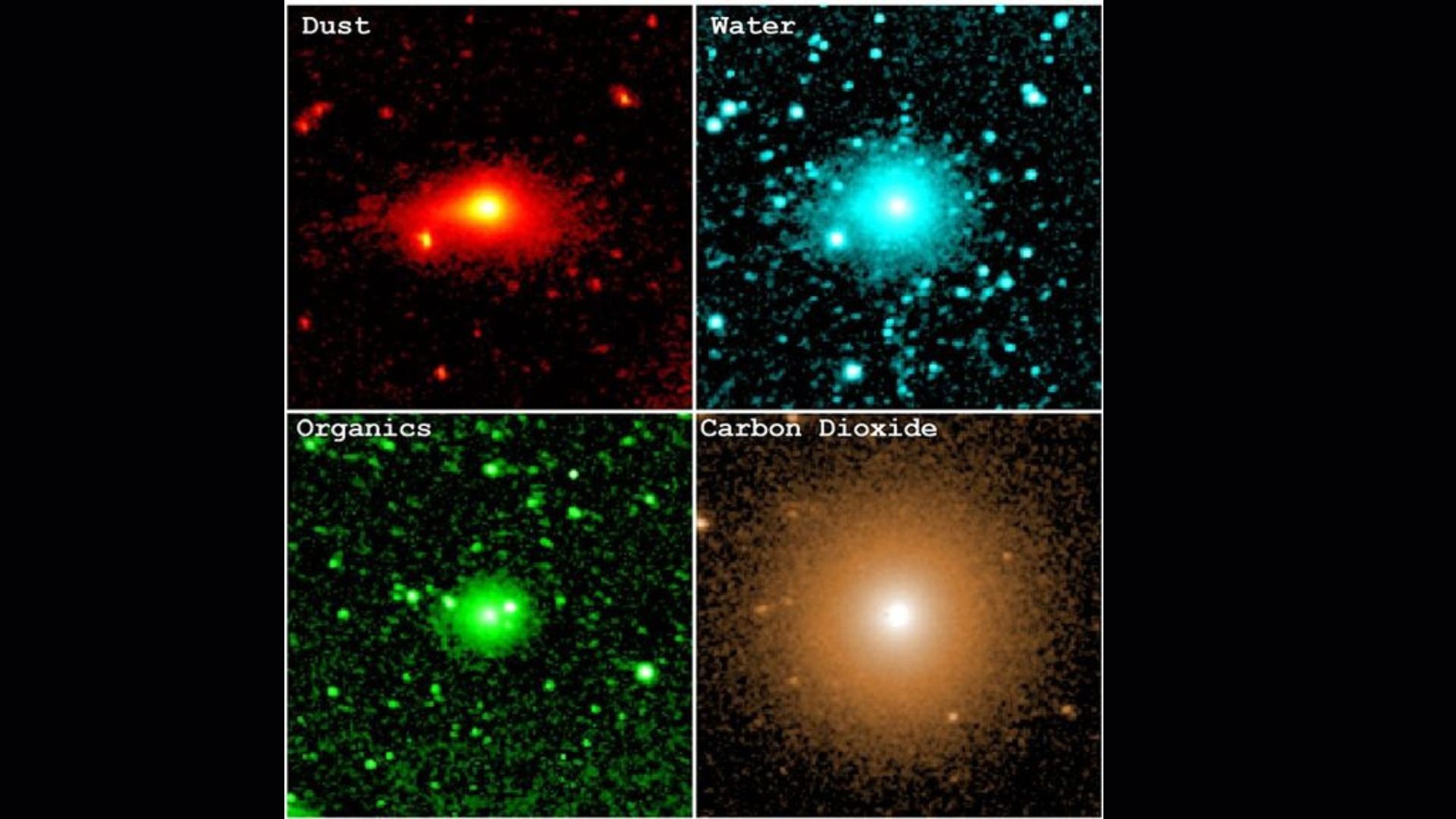
NASA’s SPHEREx telescope has detected organic molecules – including methanol, cyanide, and methane – being released from the interstellar comet 3I/ATLAS as it passed near Earth in late 2025. These compounds are critical for biological processes, though their presence does not necessarily indicate extraterrestrial life. The observations confirm that comets can eject the raw ingredients for life into space, raising questions about how such materials spread throughout the cosmos.
Comet 3I/ATLAS: A Rare Visitor
3I/ATLAS is only the third interstellar object ever confirmed in our solar system and is thought to be among the oldest comets observed. Discovered in July 2025, it travels at a staggering 137,000 mph (221,000 km/h) and likely originated from another star system billions of years ago. While speculation about it being an alien spacecraft has circulated, the scientific consensus is that it’s a natural comet.
The Science of Cometary Eruptions
As comets approach stars, their icy surfaces heat up, causing materials to sublimate into gas. This results in jets, comas, and tails, which researchers can study to determine the comet’s composition. In December 2025, 3I/ATLAS underwent a particularly strong eruption after its closest approach to the Sun, releasing abundant carbon-rich material that had been locked in subsurface ice.
“We are now seeing the usual range of early solar system materials…that are typically emitted by a comet,” said study lead author Carey Lisse, an astronomer at Johns Hopkins Applied Physics Laboratory. The findings align with the theory that comets may distribute organic molecules across the universe, potentially contributing to the emergence of life on other worlds.
SPHEREx’s Lucky Break
The SPHEREx telescope, launched in March 2025, was designed to scan the entire night sky in infrared, searching for the building blocks of life and studying gases around comets. It serendipitously captured 3I/ATLAS during its flyby from December 8–15, providing unprecedented data on an interstellar visitor shortly after the mission began.
The timing was fortunate, as stated by Yoonsoo Bach, a researcher at the Korea Astronomy and Space Science Institute: “Science is sometimes like that: You’re in the right place at the right time.”
Before exiting the solar system permanently, 3I/ATLAS will make a close pass by Jupiter, where NASA’s Juno spacecraft will take one last look. The comet’s departure will leave behind valuable insights into the composition of interstellar objects and the potential for life-bearing materials to travel between star systems.
The discovery underscores the importance of studying comets to understand the origins of organic molecules and the mechanisms that may seed life throughout the universe.