

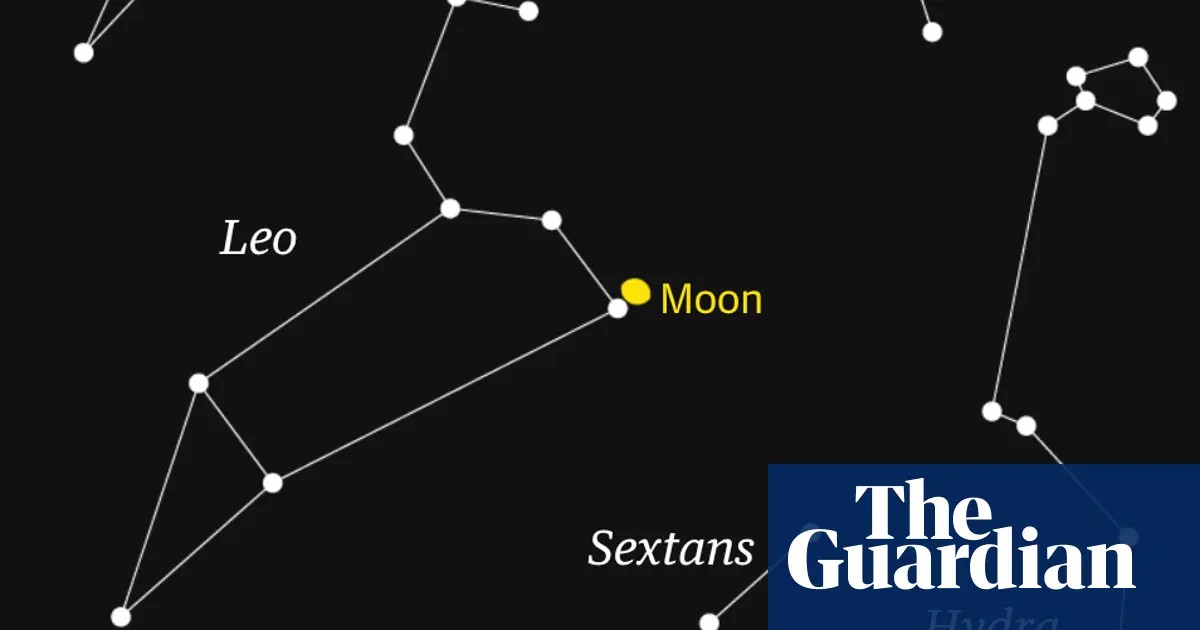
On the evening of March 29th, skywatchers will witness a rare celestial event: the moon will pass in front of Regulus, the brightest star in the constellation Leo. This phenomenon, called an occultation, happens when one celestial body obscures another. Unlike a gradual eclipse, occultations are swift and clean, with stars appearing to vanish and reappear almost instantly.
Why This Matters
Occultations are more than just beautiful sights. They provide astronomers with precise measurements of lunar features and stellar positions. Because the moon lacks an atmosphere, the star’s disappearance is sharp, allowing for highly accurate timing. This data helps refine our understanding of the moon’s shape and orbit, as well as the star’s location in the sky.
How to Observe
To see this event, look towards the western sky after sunset on March 29th. Regulus is part of Leo’s easily recognizable “sickle” asterism – a curved group of stars that form the lion’s head. Even from cities, Regulus shines brightly at magnitude 1.4, making it visible to the naked eye.
- From London, Regulus will disappear behind the moon at 7:14 PM British Summer Time (BST).
- The star will reappear from the opposite side of the moon at 9:21 PM BST.
Timings will vary slightly depending on your location within the UK, so checking a local astronomy resource for exact times is recommended. The key is to watch closely as twilight fades; the star will simply blink out as it crosses the moon’s edge.
A Quick, Sharp Show
Occultations offer a glimpse into the precision of celestial mechanics. Unlike hazy or prolonged events, the sudden disappearance and reappearance of Regulus serve as a striking reminder of the clean lines and predictable movements that govern the cosmos.
This event is a simple yet stunning demonstration of how we can use the night sky to deepen our understanding of the universe and its intricate workings.