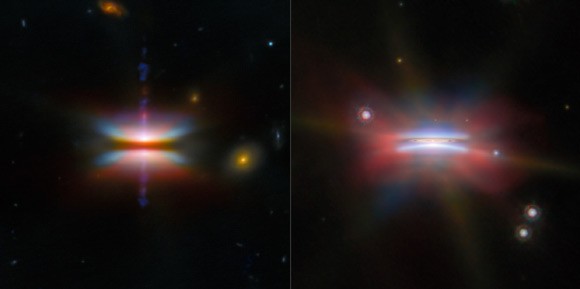
New imagery from the James Webb Space Telescope (JWST) has provided astronomers with a rare, side-on perspective of two stellar nurseries, offering a profound look at the chaotic and beautiful process of planetary birth.
Using the telescope’s NIRCam and MIRI instruments, researchers captured striking views of two young stars—Tau 042021 and Oph 163131 —each surrounded by the swirling disks of gas and dust known as protoplanetary disks.
The “Edge-On” Advantage
While many astronomical observations look down at disks from above, these two systems are oriented edge-on from Earth’s vantage point. This specific alignment is scientifically critical for several reasons:
- Natural Light Shielding: Because we are viewing the disks from the side, the intense, blinding light from the central young stars is largely blocked by the disk itself.
- Revealing the Nebula: With the central glare minimized, Webb can detect the fine dust that has risen above and below the disk. This dust is illuminated by reflected starlight, creating a glowing nebula effect.
- Mapping Composition: This view allows scientists to study the distribution of dust within and around the disk, which is the primary factor in determining where and how planets will eventually form.
From Dust to Worlds: The Lifecycle of a Solar System
The images act as a snapshot of a process that occurred billions of years ago in our own Solar System. The formation of a planetary system follows a predictable, albeit violent, cycle:
- Collapse: A dense clump of gas within a molecular cloud collapses under gravity to form a star.
- Disk Formation: The leftover gas and dust that weren’t consumed by the star begin orbiting it, forming a thick, rotating disk.
- Accretion: Over time, dust particles collide and clump together to form planetesimals —the building blocks of planets.
- Differentiation: Successful planetesimals grow into full-fledged planets (like Earth or Jupiter), while those that fail to gain enough mass remain as asteroids and comets.
- Dissipation: Eventually, the radiation from the young star blows away the remaining unconsumed gas, ending the disk’s life cycle.
Mapping the Galaxy’s Origins
The two subjects of this study are located at significant distances: Tau 042021 sits roughly 450 light-years away in the constellation Taurus, while Oph 163131 is located about 480 light-years away in Ophiuchus.
By observing these “infant” systems at such an early stage, astronomers are not just looking at distant objects; they are looking into a mirror of our own history. Understanding how these disks are structured helps scientists decode why different types of planets—from rocky terrestrial worlds to massive gas giants—form in different parts of the galaxy.
These images, resembling rainbow-colored spinning tops in the void, are more than just visual marvels; they are essential blueprints for understanding the architecture of planetary systems.
By studying these edge-on disks, astronomers are gaining the necessary context to understand how the diverse array of planets across the universe—including our own—came to be.