In the year A.D. 185, Chinese astronomers documented a startling phenomenon: a “guest star” had suddenly appeared in the night sky, shining brightly for eight months near the Alpha Centauri system. Today, that ancient observation has become the focal point of modern astrophysics.
What was once a mysterious light in the sky is now known to be RCW 86, the remnant of a massive supernova explosion. While scientists have studied this glowing ring of debris for years, new data from NASA’s Imaging X-ray Polarimetry Explorer (IXPE) is finally helping to solve a long-standing puzzle regarding its unusual behavior.
The Mystery of the Rapid Expansion
Most supernova remnants expand at a predictable rate as they plow through interstellar space. However, RCW 86 has always been an outlier. It appears to have expanded much faster than its peers, leaving astronomers questioning the environment in which the star originally exploded.
Previous observations from NASA’s Chandra X-ray Observatory suggested a theory: the star likely exploded inside a “low-density cavity.” Imagine a bubble in space where the material is much thinner than the surrounding area; if a star explodes inside such a bubble, the debris can fly outward with much less resistance, causing the rapid expansion observed by scientists.
How IXPE is Changing the Picture
While previous telescopes like Chandra and the Dark Energy Camera provided glimpses of RCW 86, the IXPE —launched in 2021—brings a specialized tool to the table: X-ray polarimetry.
Unlike standard telescopes that simply capture the brightness and color of light, IXPE measures the orientation of X-ray emissions. This allows scientists to map the magnetic-field structures within the remnant. By understanding how magnetic fields are organized, researchers can see exactly how the explosion’s energy is interacting with the surrounding space.
The “Reflected Shock” Discovery
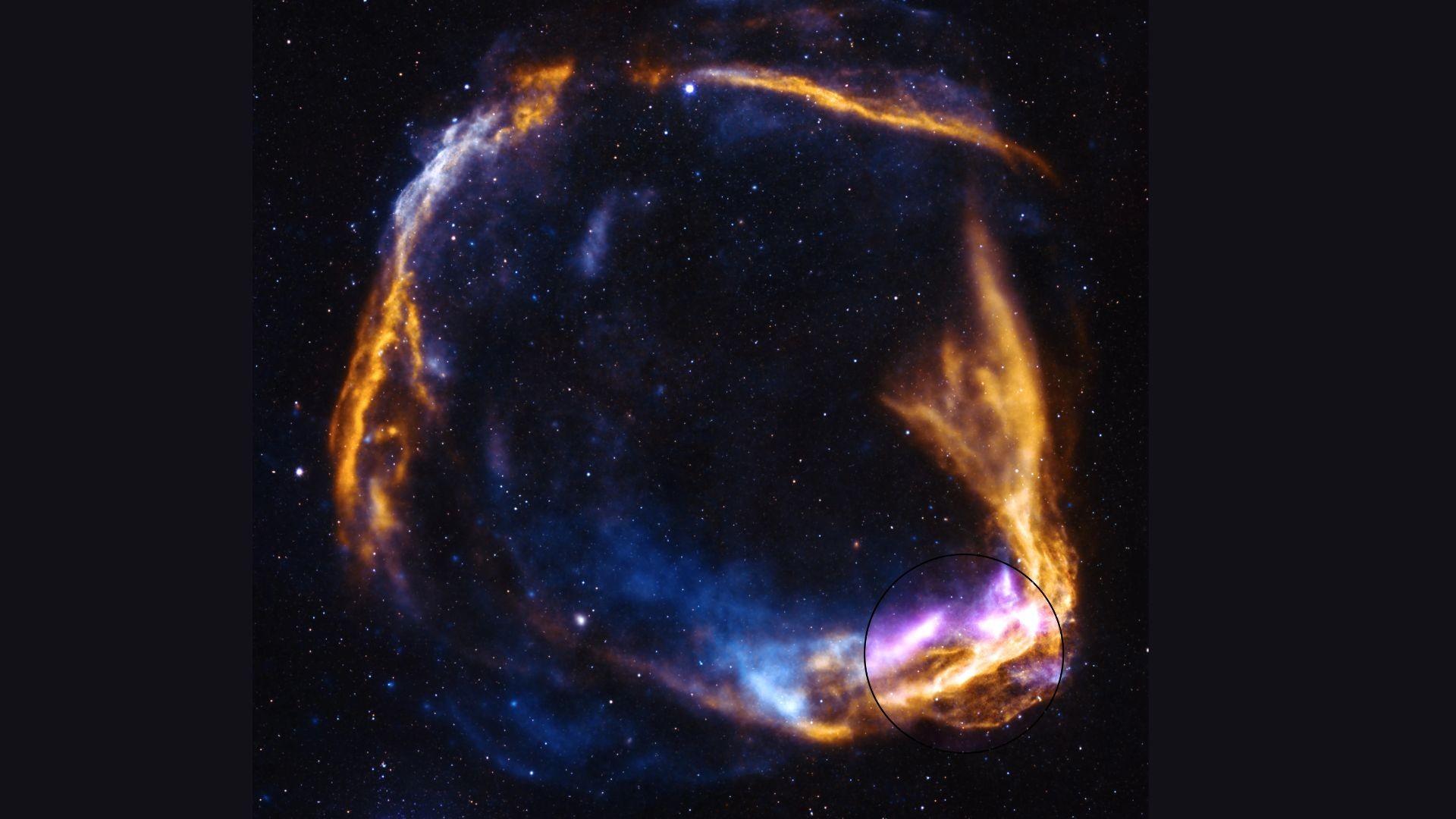
By combining IXPE data with observations from Chandra and the European Space Agency’s XMM-Newton, astronomers have produced a multi-layered view of the remnant:
* Yellow hues represent low-energy X-rays.
* Blue hues represent high-energy emissions.
* Purple regions highlight the outer rim, where the expansion finally met resistance.
The most significant finding is evidence of a “reflected shock” effect. As the supernova’s debris hit the edge of the low-density cavity, the impact sent shock waves bouncing back toward the center. This interaction explains two major mysteries:
1. The irregular shape of the remnant.
2. The distribution of high-energy particles scattered throughout the debris field.
This discovery bridges the gap between ancient celestial observations and modern high-energy physics, proving that even a 2,000-year-old event can still teach us how the universe’s most violent explosions shape the cosmos.
Conclusion
By utilizing advanced X-ray polarimetry, NASA has provided a clearer explanation for the anomalous expansion of RCW 86. The discovery of reflected shock waves confirms that the star’s environment played a decisive role in shaping the cosmic relic we see today.