



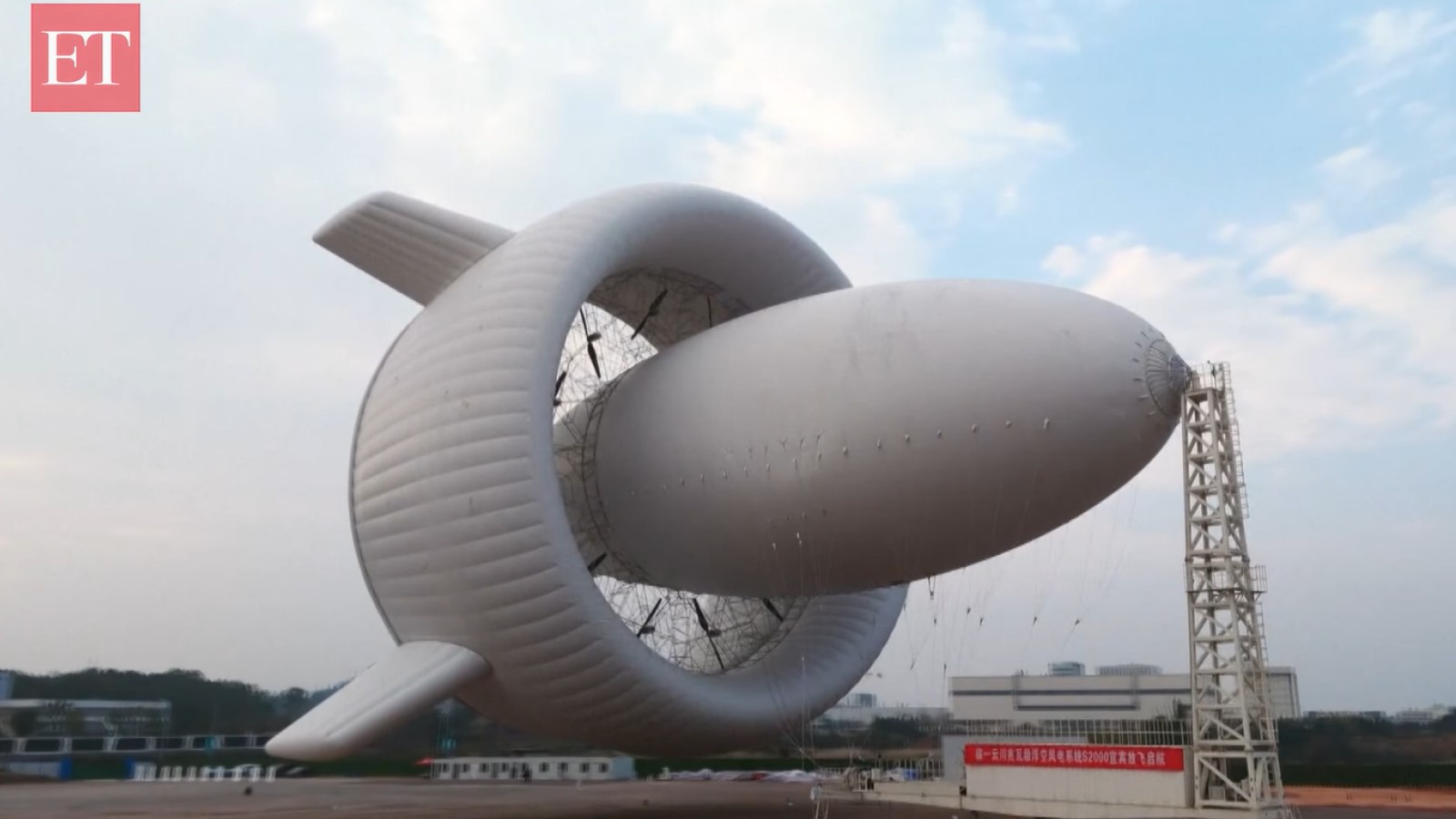
China has successfully tested a novel airborne wind energy system (AWES) – a megawatt-class flying wind turbine – demonstrating a potential leap forward in renewable energy generation. The experimental system, developed by Beijing Linyi Yunchuan Energy Technology, uses a helium-filled airship to harness stronger, more consistent winds at high altitudes.
Harnessing High-Altitude Winds
The S2000 AWES, as the system is known, is essentially a blimp equipped with 12 wind turbines. Unlike traditional ground-based or offshore wind farms, this approach taps into stable wind speeds thousands of feet in the air. The turbines convert this kinetic energy into electricity, which is then transmitted down a tethering cable to the ground for distribution.
During a recent test flight in Sichuan Province, the S2000 generated 385 kilowatt-hours of electricity at an altitude of 6,560 feet (2,000 meters). This output is sufficient to power the average U.S. household for approximately two weeks. The system boasts a total power capacity of 3 megawatts, and measures 197 feet long, 131 feet high, and 131 feet wide.
Potential Applications and Advantages
The developers envision two primary applications for this technology. First, it could provide a reliable energy source for off-grid locations like remote outposts. Second, it could supplement existing ground-based wind farms, creating a more comprehensive, three-dimensional approach to energy production. This is particularly relevant for countries with limited land or shallow seabed areas for conventional wind farms, like many European nations and Japan.
Why this matters: Traditional wind power development requires vast tracts of land or access to offshore sites. The S2000 offers a solution for energy-constrained regions, unlocking previously inaccessible wind resources.
Challenges and Considerations
While promising, the AWES concept faces several hurdles. The long tethering cable – measuring up to 1.25 miles (2,000 m) – poses potential safety risks to air traffic. Aviation authorities, like the U.K.’s Civil Aviation Authority, require permits for tethered balloons above certain altitudes to mitigate these dangers.
Furthermore, maintaining and repairing a flying turbine will be complex and costly. Unlike standard wind turbines, the S2000 will need to return to the ground for every service, raising logistical challenges. The stability and longevity of the tether itself will also require rigorous testing.
The Future of Wind Power Density
The efficiency of wind energy is directly tied to wind power density, which increases at higher altitudes. Omnidea estimates that wind power density increases up to sixfold between 328 and 8,200 feet (100 and 2,500 m). This suggests that flying wind turbines, like the S2000, could significantly improve energy harvesting.
For context: Modern offshore turbines are already pushing the boundaries of scale, with some exceeding 600 feet in height. Floating wind turbine designs are also emerging, but tethered airborne systems offer a fundamentally different approach to capturing wind energy.
The S2000 represents a bold experiment in renewable energy innovation. If these engineering and safety challenges can be overcome, it could reshape how nations generate power, particularly those with limited geographic options for traditional wind farms.