



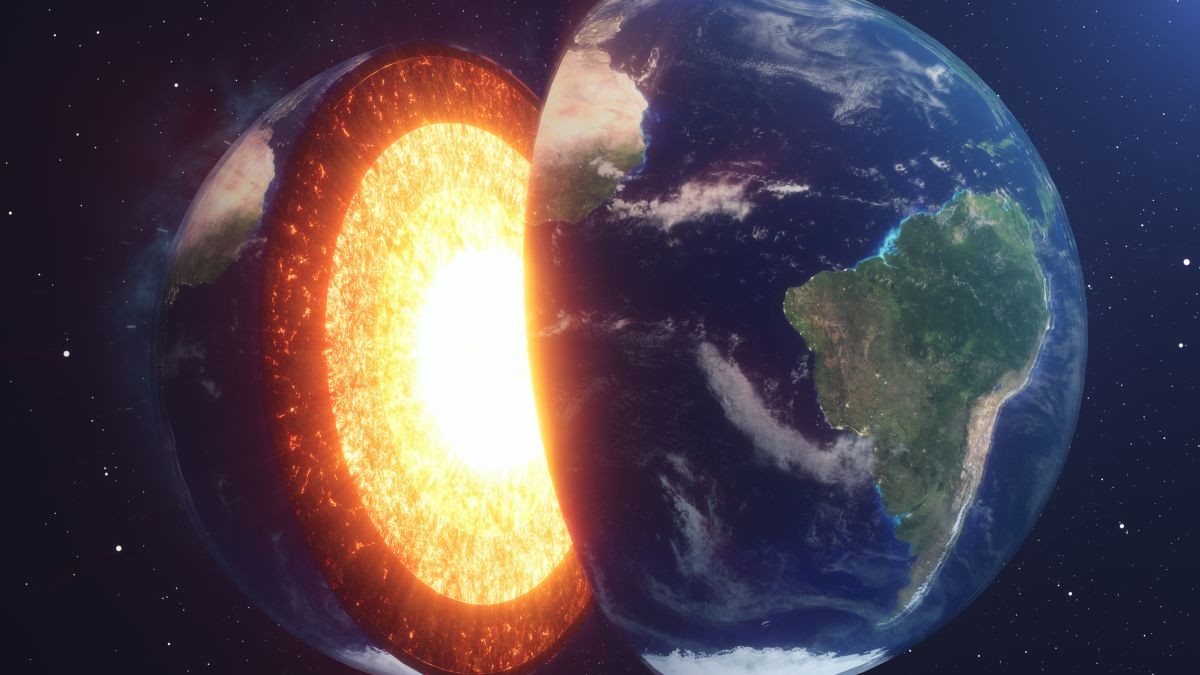
New research suggests Earth’s core contains an astonishing amount of hydrogen, potentially exceeding the total quantity found in all of the planet’s oceans by a factor of up to 45. While inaccessible, this discovery provides vital clues about Earth’s formation, magnetic field, and the origin of its water.
The Hidden Reservoir
For decades, scientists have speculated about hydrogen trapped within Earth’s core, but determining the quantity has remained elusive. A study led by Dongyang Huang at Peking University used high-pressure experiments to simulate core conditions. By squeezing iron samples with hydrated silicate glass to extreme pressures (up to 111 gigapascals) and temperatures (around 5,100 kelvins), researchers observed hydrogen bonding readily with iron, silicon, and oxygen.
This behavior suggests that during Earth’s early formation, hydrogen could have become locked within the core. Seismic data already indicates that the core isn’t pure iron, containing an estimated 2–10% silicon. Based on these findings, the team calculated that 0.07–0.36% of the core’s mass is hydrogen, equating to 1.35–6.75 sextillion kilograms.
Why This Matters
This massive hydrogen reserve challenges previous assumptions about Earth’s water origins. The prevailing theory suggests that much of Earth’s water arrived via comets during the planet’s late stages of development. However, if the core holds this much hydrogen, it implies that a significant portion of Earth’s water may have been present from the planet’s earliest accretion, rather than delivered later.
“Such an amount would require the Earth to obtain the majority of its water from the main stages of terrestrial accretion, instead of through comets during late addition.”
The implications extend beyond Earth. If this process is common, other rocky planets previously considered dry might harbor hidden water reserves deep beneath their surfaces. Understanding these deep reservoirs could fundamentally change how we assess planetary habitability.
Experimental Limits and Future Research
While the experiments don’t perfectly replicate core conditions (actual core pressure is around 136 gigapascals), they provide the closest approximation currently possible. The research highlights the limitations of studying the core directly, relying instead on simulations and calculations.
Despite these constraints, the study offers compelling evidence that Earth’s hydrogen inventory is far larger than previously estimated. Further research is needed to refine these calculations and explore how hydrogen moves within the planet over geological timescales.
In conclusion, Earth’s core may be the largest reservoir of hydrogen on the planet, holding an amount that dwarfs all of its surface water. This finding not only alters our understanding of Earth’s history but also suggests that hidden water may be more common on rocky planets than previously thought.