
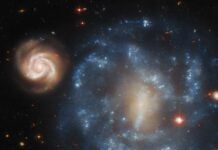



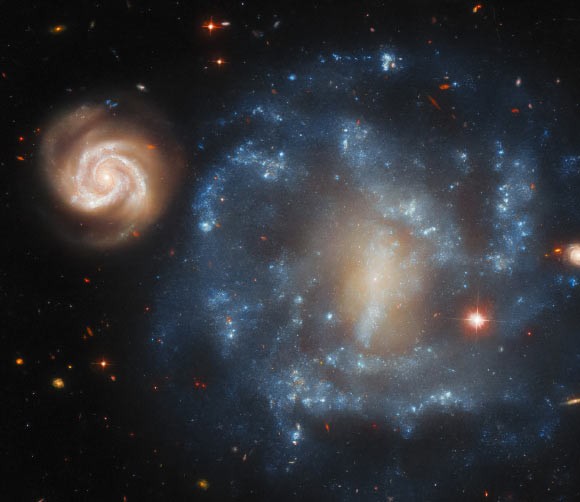
The NASA/ESA Hubble Space Telescope has delivered a remarkably detailed image of Arp 4, a visually striking pairing of two spiral galaxies located in the constellation Cetus. While appearing close in the sky, these galaxies are separated by vast cosmic distances—a testament to the deceptive nature of perspective in astronomy.
The Two Galaxies of Arp 4
Arp 4 consists of MCG-02-05-050a, a bright, active spiral galaxy, and the much larger, yet surprisingly faint, MCG-02-05-050. The pair was first identified by astronomer Sidney van den Bergh in 1959 and cataloged in Halton Arp’s Atlas of Peculiar Galaxies in the 1960s.
This catalog was designed to document unusual galactic shapes, providing scientists with examples of how galaxies evolve into non-standard forms. Arp 4 falls into the “low surface brightness” category – galaxies that are unexpectedly dim and difficult to detect. The larger galaxy, MCG-02-05-050, fits this description with its fragmented arms and faint disk.
A Cosmic Illusion
What makes Arp 4 particularly interesting is that the two galaxies are not physically close to one another. MCG-02-05-050 resides approximately 65 million light-years from Earth, while its brighter companion, MCG-02-05-050a, is over ten times further away at 675 million light-years.
“Their pairing in this image is simply an unlikely visual coincidence,” Hubble astronomers explain. “Despite this lack of a physical relation between them, our point of view on Earth allows us to enjoy the sight of Arp 4 as an odd couple in the sky.”
This phenomenon highlights how our vantage point in the universe can create misleading impressions. The two galaxies appear aligned purely by chance, offering a rare but unphysical pairing visible from Earth.
The Significance of Peculiar Galaxies
Studying galaxies like those in Arp’s atlas is crucial for understanding galactic evolution. Low surface brightness galaxies, though faint, provide clues about how structures form over cosmic time. Their dim nature suggests they may be evolving slowly or have lower star formation rates, giving astronomers insights into the broader processes that shape galactic structures.
The Hubble Space Telescope continues to provide high-resolution images of these peculiar systems, allowing scientists to refine their models of galactic development and the universe’s large-scale structure.
This image of Arp 4 is a reminder that what we see in the sky is not always what it seems—and that even the most distant objects can reveal profound truths about the cosmos.