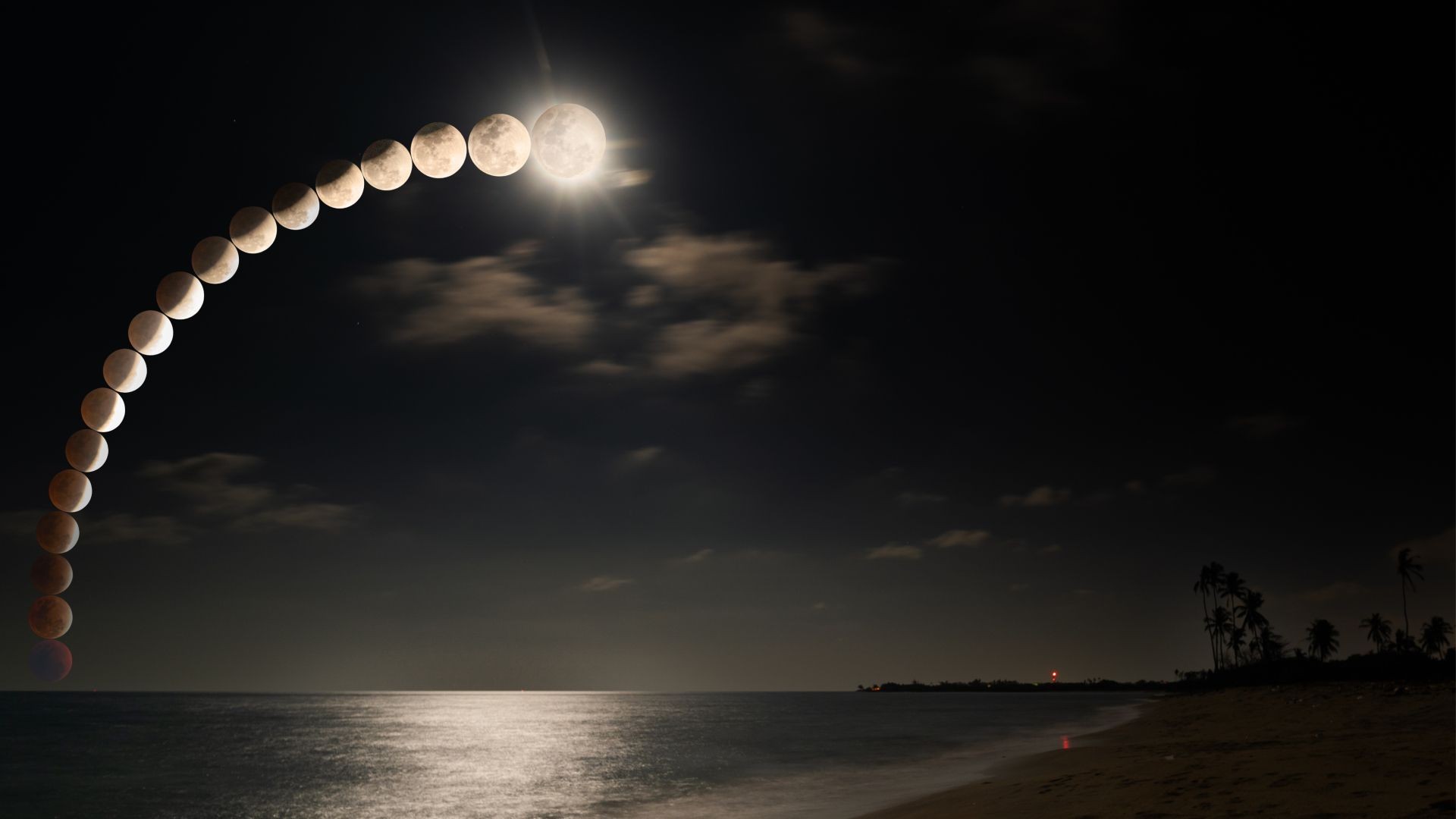
Malaysian photographer Tharuman Gnanamoorthy embarked on a last-minute, cross-country journey to document the March 3 total lunar eclipse, commonly known as a blood moon. His stunning composite images capture the eerie beauty of the fully eclipsed moon rising over Malaysia’s eastern coast, a feat made possible by relentless planning and a critical shift in location just hours before the event.
The Challenge of Celestial Timing
The weeks leading up to the eclipse found Gnanamoorthy refining his dual-imaging setup while working as a paediatrician. The key was capturing the moon as it entered totality, when Earth’s shadow transforms the lunar surface into a deep, reddish hue. This relies on the precise alignment of sun, Earth, and moon—a celestial event that demands equally precise preparation.
Gnanamoorthy meticulously scouted locations using tools like Google Earth and Photopills, initially targeting the western coast of Malaysia. However, deteriorating weather forced him to abandon his original plan and drive over 310 miles north to the eastern shoreline near Kota Bharu, gambling on clearer skies over the South China Sea.
A Last-Minute Decision, A Seven-Hour Drive
“Faced with this uncertainty, I made a last-minute decision to drive across the country,” Gnanamoorthy recounted. The rush against sunset meant a seven-hour drive with no time to waste. He needed to arrive before twilight to secure a vantage point and set up his Sony A7 III mirrorless camera with a 300 mm lens, alongside a Seestar S50 smart telescope.
The Moment of Clarity
Gnanamoorthy settled on Pantai Pak Amat beach, hoping for a clear horizon. But the moon rose behind a wall of clouds. Just as the peak of totality began to slip away, the clouds parted, revealing the eclipsed lunar disk bathed in a haunting, orange-red light.
“It was an incredible moment,” Gnanamoorthy recalled. “For a brief instant, I simply stood there, stunned. Then instinct took over.” He seamlessly switched between the mirrorless camera for bracketed exposures and the smart telescope for RAW footage.
A Historical Setting
Gnanamoorthy combined the images using Adobe Photoshop and Lightroom, creating striking compositions that documented the moon’s transformation from crimson to silver.
Interestingly, the beach itself holds historical significance as the landing site of Japanese forces during World War II. Gnanamoorthy later photographed a monument there, capturing the Milky Way core rising above the same coastline.
The photographer’s dedication and adaptability prove that capturing rare celestial events requires not only technical skill but also a willingness to chase clarity against all odds.