



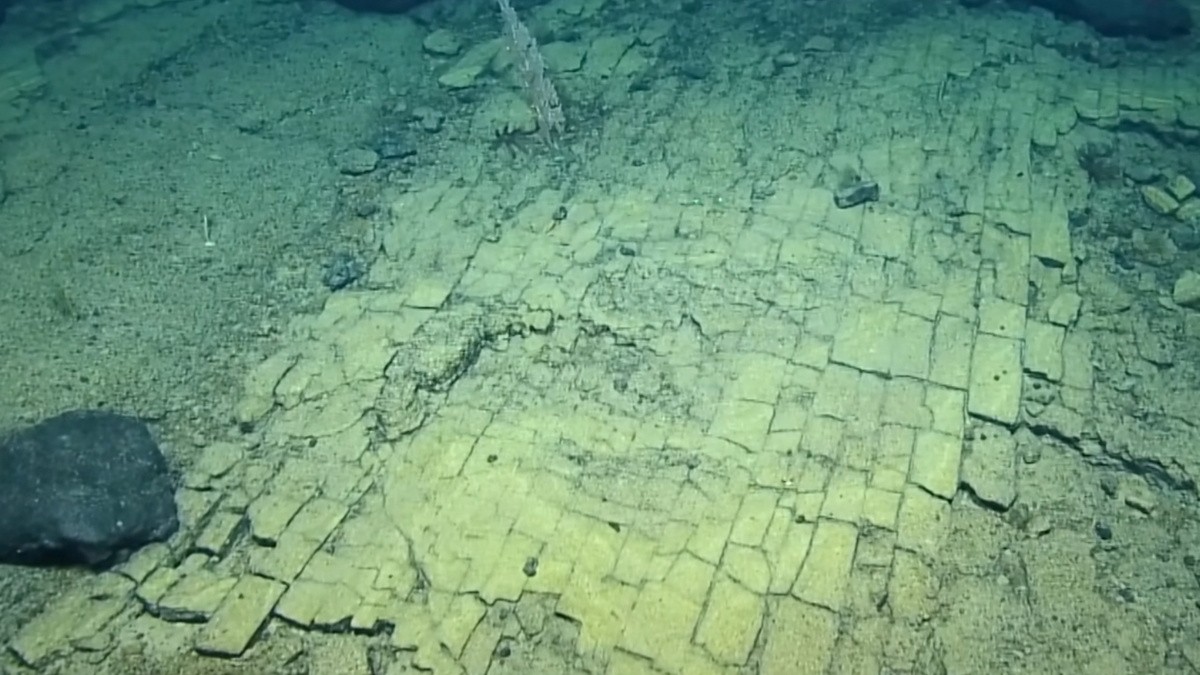
During a deep-sea expedition to the Liliʻuokalani Ridge, north of the Hawaiian Islands, researchers stumbled upon a geological formation so striking it was immediately compared to the “Yellow Brick Road” from The Wizard of Oz.
Located more than 3,000 meters (9,843 feet) below the surface, the discovery was made by the exploration vessel Nautilus, operated by the Ocean Exploration Trust, within the Papahānaumokuākea Marine National Monument (PMNM).
A “Baked” Landscape in the Abyss
The discovery took place on the summit of the Nootka seamount. Despite being submerged under a vast expanse of ocean, the lakebed appeared strangely “dry,” resembling a parched, crusty surface.
Geologists have identified this phenomenon as a fractured flow of hyaloclastite. This type of volcanic rock forms during high-energy eruptions, where fragmented rock settles onto the seabed. The “brick-like” appearance is the result of specific geological stresses:
– Thermal Stress: The rock underwent intense heating and cooling cycles from multiple volcanic eruptions.
– 90-Degree Fracturing: These temperature fluctuations caused the volcanic margin to crack in precise, angular patterns, creating a visual effect that mimics a paved path.
While the researchers jokingly referred to it as the “road to Atlantis,” the formation is a testament to the violent and transformative volcanic processes that shape our ocean floors.
The Great Unknown: Mapping the Deep Sea
This discovery highlights a staggering reality: we have barely scratched the surface of our own planet.
The Papahānaumokuākea Marine National Monument is one of the largest marine conservation areas on Earth—surpassing the combined size of all U.S. national parks—yet only about 3% of its seafloor has been explored.
A recent study by the Ocean Discovery League, the Scripps Institution of Oceanography, and Boston University provides a sobering perspective on our lack of oceanic knowledge. By analyzing 67 years of deep-sea dive data, researchers found that:
– Humans have visually explored between 0.0006% and 0.001% of the deep seafloor.
– Even at the highest estimate, the total area imaged is only about 3,823 square kilometers —roughly the size of Rhode Island.
Why This Matters
The “Yellow Brick Road” is more than just a visual curiosity; it is a gateway to understanding deep-sea ecosystems. By studying these ancient seamounts and their unique geological structures, scientists can better understand the habitats that support life on the rocky slopes of the deep ocean.
As exploration technology advances, these “bizarre” and “crazy” discoveries serve as reminders that the vast majority of Earth’s largest ecosystem remains a mystery waiting to be mapped.
The discovery of unique geological formations like the hyaloclastite “road” underscores how much of the deep ocean remains a frontier, offering endless opportunities to reshape our understanding of Earth’s hidden geology.