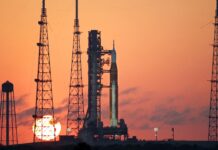
NASA’s Artemis 2 mission marked a historic moment on April 1, 2026, as the Space Launch System (SLS) rocket propelled the Orion spacecraft toward the moon. The launch was not only witnessed from Earth but also documented by the GOES-19 weather satellite, capturing a dramatic plume of exhaust against the night sky.
A Landmark Mission
This mission signifies the first crewed lunar voyage since Apollo 17 in 1972. The four astronauts – Jeremy Hansen, Christina Koch, Reid Wiseman, and Victor Glover – are embarking on a 10-day journey that will carry them farther into deep space than any previous human expedition. While Artemis 2 does not include a lunar landing, it paves the way for future Artemis missions, specifically Artemis 4 and 5, which will return humans to the lunar surface for the first time in over 50 years.
Why This Matters
The Artemis program represents a renewed commitment to lunar exploration and a critical step toward establishing a sustainable presence beyond Earth. The program’s long-term goals include using the moon as a stepping stone for future missions to Mars and other destinations in the solar system. The crew’s journey will test critical systems and procedures for lunar surface operations, ensuring that when boots hit the moon again, it will be done safely and efficiently.
The launch itself highlights advances in rocketry and space technology. The SLS, NASA’s most powerful rocket ever built, showcases the capabilities required for deep-space missions. The GOES-19 satellite’s capture of the event demonstrates how modern weather and space-based observation tools can provide unique perspectives on critical events.
Artemis 2 is not just a symbolic return to the moon; it is a practical step toward building the infrastructure for a sustained human presence in space.
For ongoing updates, follow the Artemis 2 mission live updates page. This mission is a testament to human ambition and the relentless pursuit of exploration.