




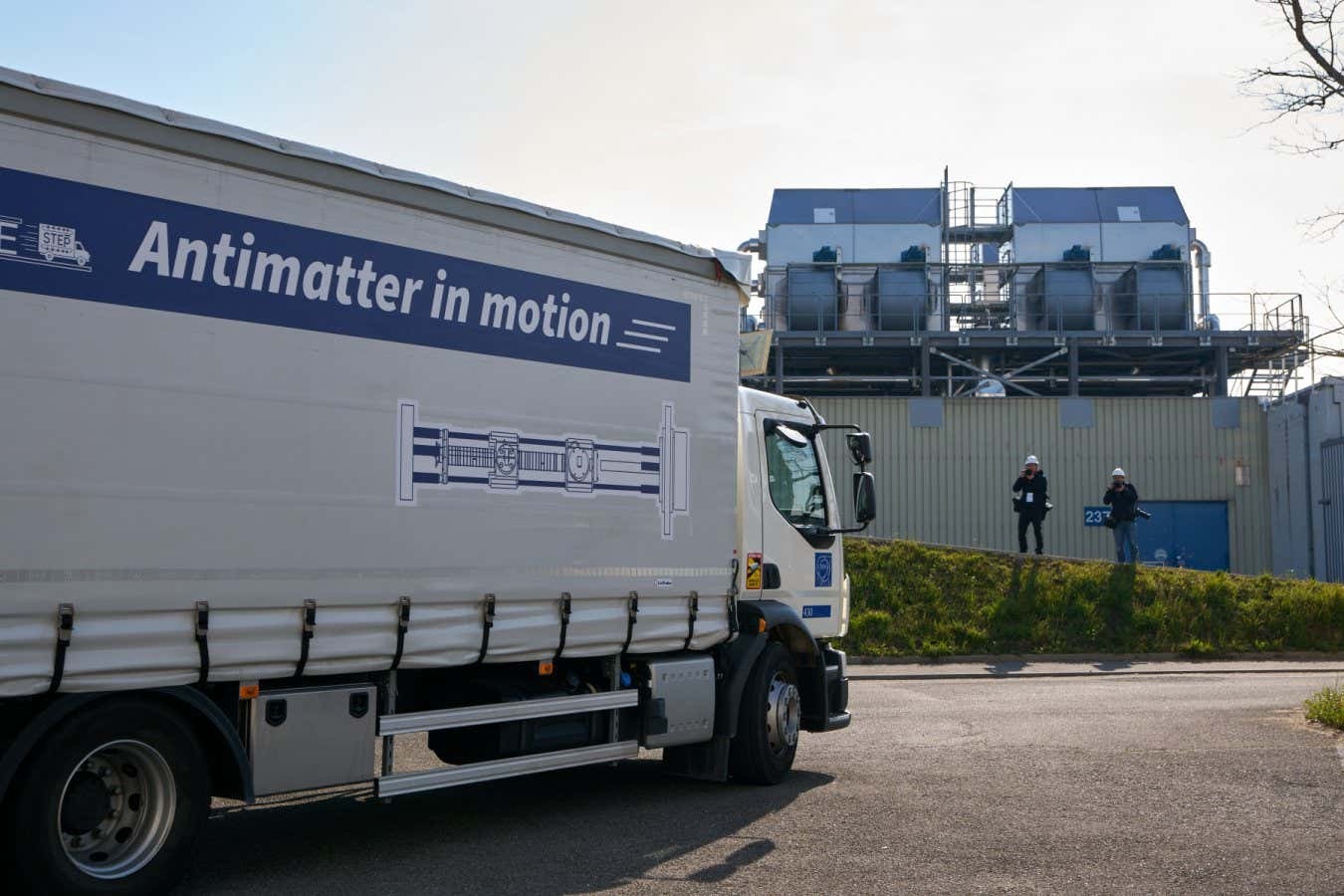
For the first time, antimatter has been successfully transported via conventional road transport. A small sample – approximately 100 antiprotons – completed a 20-minute journey on the back of a lorry within the CERN particle physics laboratory campus near Geneva, Switzerland. This milestone marks the initial test of a planned antimatter delivery service, intended to provide on-demand access to antiprotons for laboratories across Europe seeking to study their unique properties.
The Challenge of Handling Antimatter
Antimatter is the mirror image of ordinary matter, possessing the same mass but opposite charge. When matter and antimatter collide, they annihilate each other, releasing energy – a characteristic that makes antimatter exceptionally difficult to contain and study.
Only in recent decades have facilities like CERN’s Antimatter Decelerator (often called the “antimatter factory”) achieved the ability to produce and store enough antimatter, specifically antiprotons, for experimental research. The ultimate goal is to understand why our universe is dominated by matter rather than antimatter.
The STEP Project: Portable Antimatter Transport
The successful transport was made possible by the Symmetry Tests in Experiments with Portable antiprotons (STEP) project. This initiative developed a specialized container using liquid helium and strong magnetic fields to slow down and isolate antiprotons. The system allows researchers to conduct high-precision measurements without the interference from electromagnetic noise prevalent in CERN’s experimental halls.
On the test run, the STEP project carried 92 antiprotons along a 4-kilometer loop on the CERN campus. The cargo remained intact throughout the journey.
Future Implications and Obstacles
According to Jeffrey Hangst of Aarhus University, who leads the ALPHA experiment studying antihydrogen atoms, this breakthrough will “open up many more years of precision measurements” by eliminating interference from laboratory noise. The team hopes to expand the STEP project’s range, eventually enabling antimatter delivery to magnetically shielded facilities throughout Europe.
However, significant hurdles remain. CERN is scheduled for major upgrades to the Large Hadron Collider, which will limit operations until at least 2028. Scaling up the transport infrastructure and ensuring the safety of antimatter deliveries will require further development and refinement.
This demonstration represents a critical step towards making antimatter more accessible for scientific study, potentially unlocking deeper insights into the fundamental asymmetry of the universe.