


New analysis of decades-old data from NASA’s Galileo mission confirms the presence of ammonia-bearing compounds on Jupiter’s moon Europa for the first time. This discovery is significant because it suggests a potential connection between Europa’s subsurface ocean and its surface, and provides critical insights into the moon’s habitability.
The Significance of Ammonia
Ammonia acts as a natural “antifreeze,” lowering the freezing point of water by up to 100 Kelvin (roughly -173°C). This means that even in the frigid conditions of the outer Solar System, ammonia can help maintain liquid water oceans beneath icy shells. The presence of ammonia doesn’t guarantee life, but it dramatically increases the chances. Europa is believed to harbor a vast saltwater ocean under a thick layer of ice. Ammonia could stabilize this ocean, making it more hospitable to potential life forms.
How the Discovery Was Made
Dr. Al Emran, a researcher at NASA’s Jet Propulsion Laboratory, re-examined archival data from the Near Infrared Mapping Spectrometer (NIMS) on the Galileo spacecraft, which flew by Europa in the 1990s. He identified a distinct ammonia absorption feature in the spectra at 2.20 microns. The most likely candidates for this signal are ammonia hydrate and ammonium chloride.
The key here is that ammonia doesn’t stick around for long in the harsh radiation environment of Jupiter. Its presence suggests that these compounds were recently transported from Europa’s subsurface ocean to the surface. This could happen through cryovolcanism (icy volcanoes) or similar geological processes.
Implications for Europa’s Structure and Ocean
The detection of ammonia implies a thinner ice shell than previously thought. A thicker shell would have allowed the ammonia to degrade before reaching the surface. The presence of ammonia also suggests that Europa’s ocean is chemically reduced and has a high pH. This environment could be favorable for certain types of life.
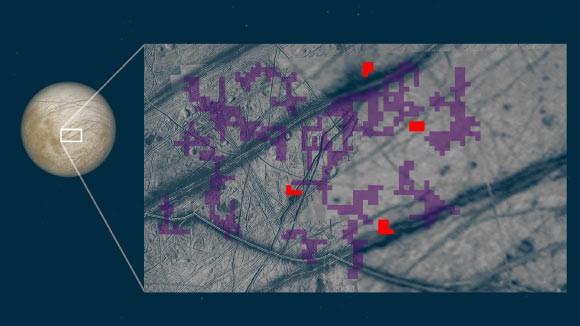
“Hidden in the data were faint signals of ammonia near fractures on the moon’s frozen surface, through which liquid water containing dissolved ammonia compounds would be expected to rise.” – Dr. Al Emran
Why This Matters Beyond Europa
While ammonia-bearing species have been found on other icy bodies (Pluto, Enceladus, etc.), this is the first definitive detection on Europa. Nitrogen is a fundamental building block of life as we know it, so finding nitrogen-bearing compounds increases the astrobiological interest in Europa. Future missions like NASA’s Europa Clipper and ESA’s JUICE will further investigate this moon’s potential habitability.
This discovery emphasizes that Europa is a dynamic world with ongoing geological activity. The ammonia signal is not just a static presence; it’s evidence of a process actively bringing material from the ocean to the surface, making it a prime target in the search for extraterrestrial life.