




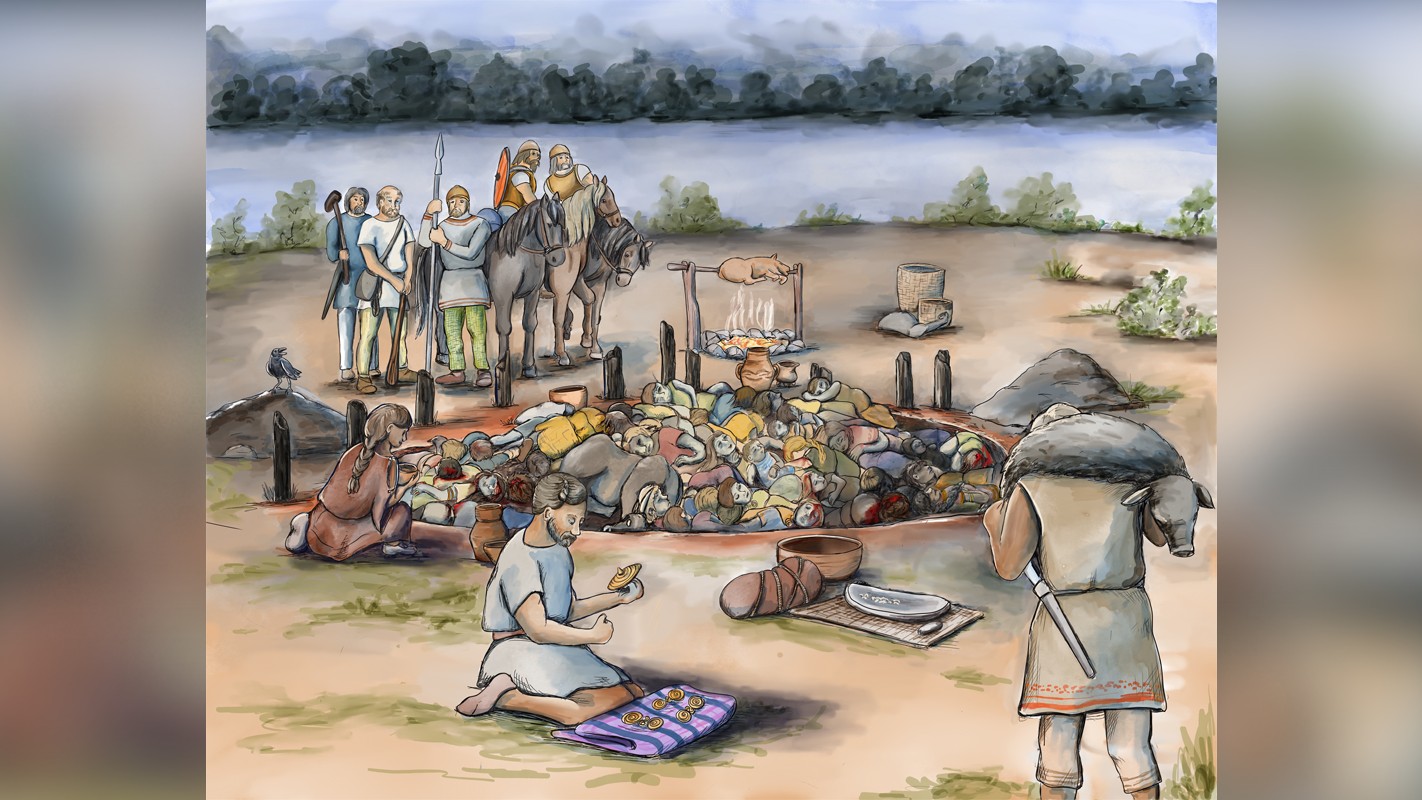
Archaeologists have unearthed a mass grave in Serbia dating back 2,800 years, containing the remains of women and children who were systematically murdered. The discovery sheds light on the early development of organized brutality in the European Iron Age, suggesting a calculated strategy of violence.
Site and Historical Context
The site, located near the modern town of Hrtkovci, has been inhabited since the sixth millennium B.C., witnessing cycles of settlement and migration. By the ninth century B.C., the region saw increasing tension between nomadic and settled groups over land ownership and resources. This period was marked by conflict as populations shifted and consolidated around strategic locations like Gomolava. The site itself was at a critical intersection—both geographically and politically—making it a flashpoint for violence.
The Discovery: Brutality and Efficiency
The grave, small in size (under 10 feet in diameter and 1.6 feet deep), held the remains of 77 individuals. More than 70% were female, and 69% were children. Evidence from the skeletons reveals extensive, intentional trauma, primarily to the head, suggesting brutal, close-range attacks with blunt-force weapons. The positioning of injuries implies the attackers may have had a height or mobility advantage, possibly through horseback. Researchers describe the violence as “severe, deliberate, and efficient.” The grave also contained animal remains, including a complete young cow skeleton at the bottom, possibly as part of a ritual or symbolic act.
Heterogeneous Victims: No Family Ties
DNA analysis showed minimal close familial connections among the victims, ruling out a simple raid on a single settlement. Additionally, strontium isotope analysis of dental enamel indicated that over one-third of those buried were not local to the Gomolava region, suggesting the victims were collected from multiple locations. This points to a deliberate act of assembling and killing individuals from diverse backgrounds.
Potential Motivations and Theories
The exact reason for the violence remains unknown, but the period was marked by instability. The influx of different cultural groups into the Carpathian Basin, combined with tensions over land use, may have fueled conflict. Researchers propose that the killings were not random but rather aimed at disrupting enemy communities by eliminating women and children—vital for their survival and future generations.
Evidence of Deliberate Disruption
A second mass grave from the same period was discovered in 1954 at the same site. The presence of both graves, containing human remains alongside valuable objects, suggests that the killings may have been part of a larger strategy to destabilize rival groups. The researchers conclude that the violence was a calculated method of conflict resolution, designed to assert power and eradicate opposition.
This discovery is significant because it provides rare insight into the development of systematic violence in prehistoric Europe. The evidence suggests that organized brutality was not a later invention but a calculated tool used by early societies to resolve conflicts and control territory.