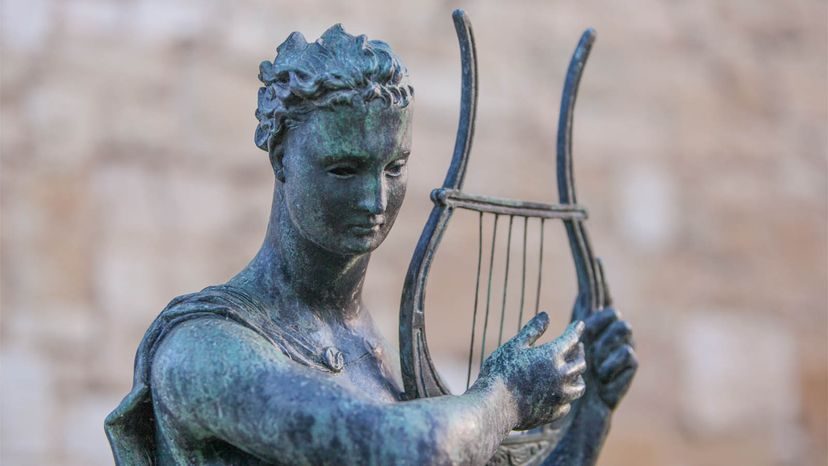
You probably won’t see a lyre on your local Spotify Wrapped set. Although not a representation of modern music, this instrument played a large role in ancient Greek culture. But the story doesn’t start in Greece. Early versions of this stringed instrument are believed to have originated in the ancient Near East, long before it became the soundtrack to private drinking parties and religious ceremonies.
How the ancient Lyra evolved from its larger predecessors
Stanford University classics professor Richard P. Martin said the lyre’s lineage are older than most people realize. Different versions of the lyre appeared in Mesopotamia and the Middle East around 2000 BC. These were not the small handheld instruments we imagine today. They were larger “box” lyres, sometimes so large that they had to be placed on the ground like modern lyres.
“At least one ancient statue from about 2500 BC, found in the Aegean islands (later Greece), depicts a seated man playing a large lyre-like instrument on his knees,” explains Martin.
This suggests that the tradition of playing lyre-like instruments came from the Middle East to the Aegean region thousands of years before the time of the ancient Greeks.
The traditional structure and materials of the lyre
So what are these old instruments like? The traditional Lyre has two solid vertical arms called pecheis or horns (kerata ) connected by a horizontal bar called a zygos. Tuning pegs or “kollopes” were made of durable materials such as bronze, bone, ivory and wood.
This instrument usually has seven strings (neurai or chordai ). These strings are of the same length but of different thickness and are strung between the crossbar and the fixed back piece (chordotonon ).
The presence of this instrument in history is well documented. “The lyre dates back several thousand years before the Common Era and is mentioned in many the Hebrew Bible and hymns in the Greek from Homer’s Iliad and Odyssey,” says professional musician Dave Mostert. “Because of the biblical references, the lyre is sometimes used as a symbol of authority in Western culture.”
Bowl Lyres and ancient Greek Symposia
The lyre that many of us are familiar with today is the “bowl” lyre, often associated with Greek culture. According to Martin, this version was invented after 1000 B.C.E.
It’s a completely different beast. “It’s small, light, has three to 11 strings, and you can pluck the strings,” he notes. This model is perfect for private entertainment at drinking parties (also known as symposiums). It’s not too noisy. The voices in the room are heard better, creating an intimate atmosphere for enjoying conversation and poetry.
Where did the transition from the large box-shaped lyre to the portable bowl-shaped lyre occur? Maybe it’s the desire for mobility. The bowl-shaped lyre could be placed on the lap and played while moving, making it easily integrated into the social structure of ancient Greek life. It is more than just an instrument. It is a unifying tool used in contexts where words and music intertwine.
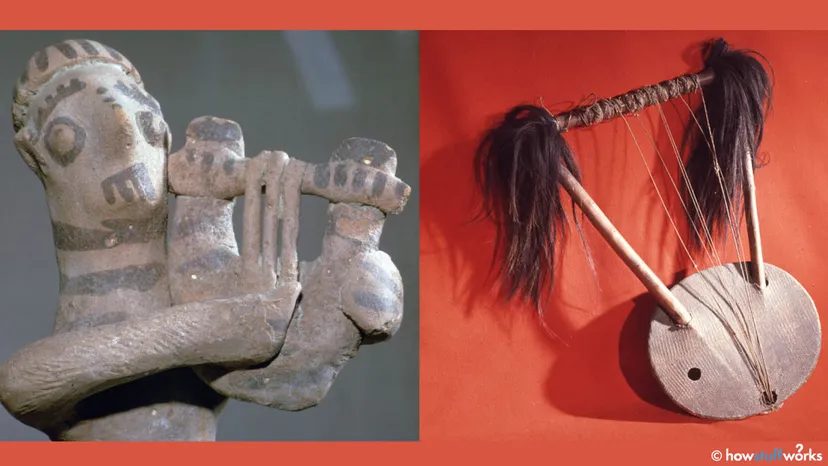

The real history of the lyre is complicated. It all depends on how you define your instrument. Is it a specific device or just a small handheld string instrument? Martin points out that if you look around, you can find these types of instruments everywhere from the Mediterranean to India and much of Africa. But where do they actually come from?
Opinions are divided among musicologists. One theory is that one ancient prototype spread outward, and different cultures borrowed and adapted its design over time. Opposing views argue that these instruments are independent creations with no direct connection and occur in different regions. Anyway, the lyre is mainstream.
Kithara: Big, boxy and competitive
The small lyre was an established part of Greek celebrations, but heavier lyres also grew in popularity. The Greeks called it kithara.
It’s not just an enlarged version of the regular lyre. It has a box-like resonance box and is played with a plectrum or fingers. This design produces a unique and powerful sound. Kithara is not meant for playing in the backyard. It is an instrument chosen in music competitions and used for solos and to accompany singers.
It is also used in official ceremonies. This song can be heard in paean, which are public songs of praise to the gods for the purpose of giving thanks and celebrating victory. This is serious music for serious situations.
Old materials and changing forms
The physical structure of these early instruments tells a different story than the polished marble statues suggest. According to Mostert, the earliest lyres were probably made from the forearm bones of sheep, goats or donkeys. This is an easily accessible and highly durable resource.
We know this through visual records. Sumerian inscriptions from around 2000 BC depict these instruments, indicating that they existed in Mesopotamia long before the Greek Golden Age. During the classical era, the lyre was everywhere. They often appear in Greek vase paintings that capture moments of music or leisure.
However, the devices are not static. Historians note that the main shape of the lyre has changed significantly over the years. One era may favor deeply curved sound boxes, while the next may favor flatter, wider frames. The instrument evolved as quickly as the music it carried, changing from an bone-and-string utility to a symbol of cultural prestige.
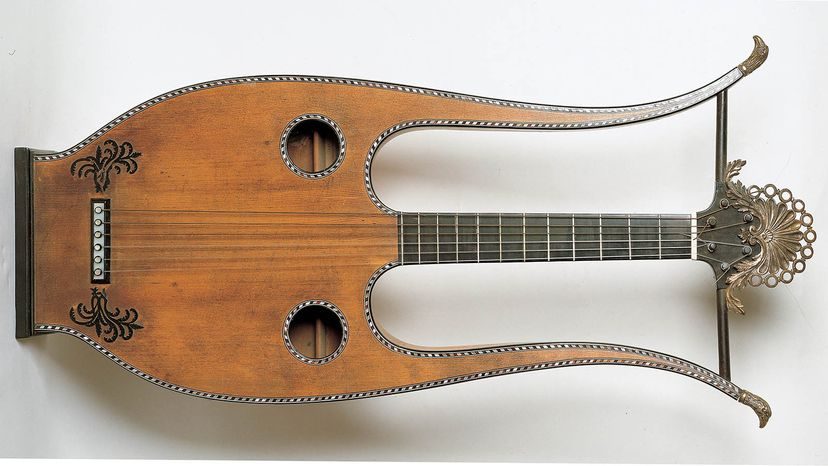
How ancient musicians tuned their songs without technology
Let’s be honest: tuning stringed instruments is often a pain these days because of flashing apps and metal forks. But what if we go back to the ancient world? There are no electronic devices. There is no tuning fork. Just raw math.
Wake Forest University physics professor Jed Macosko points out that the early lyre players were essentially mathematicians. Logic should be used to control devices instead of gadgets. Now let’s move on to the story of Pythagoras. You know that guy from geometry class. His students were the first to notice that the pitches of the strings were not random. It depends on the length.
The tension is even. The weights are the same. Different lengths produce different tones.
“The ratio of the lengths of these strings is very important.”
Pythagoras understood why four strings produce such a wonderful sound when combined. He gives players a way to be consistent. This is not magic. It was ratio. It worked.
The Sound: Tiny, Tinnier, and Delicate
If you’ve never heard a lyre, imagine a Hawaiian slack-key guitar. Now shrink it. Make it tinnier. That’s the vibe by composer Michael Levy in his reconstruction videos.
“They sound like Hawaiian slack-key guitars, only tinnier.”
Acoustic observer Martin nails the comparison. But there are physical reasons for this subtle tone. When force is applied, the string is stretched against the body. The result? A sound that is light. Airy. Not powerful.
It was not made for an orchestra. You won’t hear the sound drowning out a brass section. This is for intimacy. To listen carefully.
Hermes, Apollo and the first harp
Mythology loves a good origin story. And the lyre has one with a murder mystery twist.
The trickster god Hermes was only one day old when he went to work. He lured a tortoise into his home. Killed it. Gutted it. He used the hollow shell as a body and covered it with skin. Then came the strings: seven cords made of sheep gut.
He didn’t just make instruments. He built a bribe.
Then Hermes stole Apollo’s cattle. When the older god tracked him down and were about to punish the child, Hermes played the harp. He didn’t apologize. He performed.
Apollo was enchanted. The music was so good that they made a deal. Apollo took the lyre. Hermes received a golden rod and the power of divination. Two gods. One instrument. A trade that shaped music history.
Hercules, Orpheus and the sky
The lyre didn’t just charm gods. It caused problems for heroes too.
Young Heracles, also known as Hercules, had a short temper. His first music teacher was Linus. Linus tried to correct the boy’s playing style. Heracles cracked him over the head with the lyre. Dead.
Next up is Orpheus. A singer who can move rocks and trees. He played the harp so intensely that nature itself responded. When he was finally killed, the gods did not let his music die with him. They placed his lyre in the sky. I became Lyra. I can still see it. Still humming in the dark.
Where does Lila live now
The word “lyrical” comes from this instrument. Ancient songs were sung to the accompaniment of the Lyre. Apollo, god of the bow, is often seen alongside the great Cythala. But he also played the harp. Old vase paintings testify to this.
There is a strange relationship between archery and music. In some parts of South Africa, hunting bows are still converted into musical instruments. Multitasking. Like Apollo’s bow and harp.
But this harp is more than just a museum piece. It still lives on the island of Crete.
Summer in Crete means a big poster. Every weekend. club. site. Lyra player. they sing together. Some recited short Cretan poems to the music.
The Cretan lyre differs from the ancient plucked lyre. Play with a bow. Probably a descendant of medieval Byzantine instruments. You can see its folk version in the Plaka area of Athens. In a wonderful museum.
It’s still there. I’m waiting for someone to choose me.