



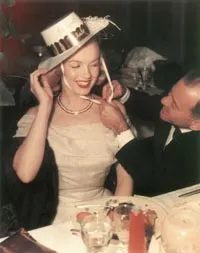
Hollywood judges you by your hairdo, not your soul. Or so goes the cynical wisdom often attributed to Marilyn Monroe herself. She once noted that the industry pays a thousand dollars for a kiss and fifty cents for your spirit. She knew the price because she held out for those fifty cents. But before she could fully grasp the cost of stardom, a man named Johnny Hyde taught her how to play the game.
It started at the Racquet Club in Palm Springs. That is where William Morris Agency executive vice president Johnny Hyde first crossed paths with Marilyn Monroe. She was twenty-two. He was fifty-three.
Most Hollywood suits she had encountered lacked refinement. Hyde was different. He possessed a low-pressure style that didn’t scream for attention. Marilyn sensed the taste in him immediately. It wasn’t just attraction. It was recognition of power.
Hyde wasn’t new to the business. He had been with William Morris for over three decades. His roster included heavy hitters like Rita Hayworth and Betty Hutton. He also represented actors such as Howard Keel, John Hodiak, Dale Evans, and Guy Madison. But his reputation wasn’t built on simple representation. It was built on guidance.
They became friends almost instantly. Hyde began taking Marilyn around to the notable establishments in Hollywood. He wanted her seen. He wanted her known.
His health was failing. Heart disease plagued him. Doctors warned him to slow down. He did the opposite. He accelerated his work schedule to cement Marilyn’s career. It was a desperate push. A final major effort before time ran out.
Hyde had been married to Mozelle Cravens for a long time. Despite that, he fell hard for his client. She was vibrant. She was beautiful. He proposed repeatedly. There were promises involved too. He offered her a small fortune in his will if she would marry him.
She said no.
Marilyn didn’t love him with that same burning passion. She respected him. She admired his reputation. But she wasn’t going to take financial advantage of a man who was dying for her. It would have felt wrong.
He was short in stature. Big in influence. He steered every career-related facet of her life. He didn’t just manage her. He curated her.
Hyde arranged cosmetic surgery. Two blemishes came off her chin. Her nose received a slight reshaping. He hired the best hairdressers for regular coloring. He bought her clothes for every occasion. He was building the brand.
The role that mattered came next. The Asphalt Jungle.
John Huston was directing the searing drama. Talent scout Lucille Ryman at MGM heard about the part. She kept an eye open for Marilyn. When Ryman sent the script to Hyde, he didn’t hesitate. He secured the audition almost immediately.
“He not only knew me, he knew Norma Jeane, too,” Marilyn later reflected.
She understood the depth of his feeling. She knew about the pain inside her. The desperate things. When he held her and said he loved her, she knew it was true. Nobody had ever loved her like that.
“I wished with all my heart I could love him back.”
She couldn’t.
Hyde’s influence extended far beyond just getting her in the door of a film. He was shaping the woman who would become an icon. The surgery. The hair. The clothes. The audition. It was all there.
He died shortly after. The world wouldn’t fully grasp Marilyn’s ascent until later. But the foundation was laid by Hyde. It was built on a fragile friendship. And a transaction of sorts.
Who else could have seen Norma Jeane before she was Marilyn? Who else would have spent their final days ensuring she had the right nose? It’s a messy history. A complicated one.
The asphalt street awaited. And she was ready to walk it.
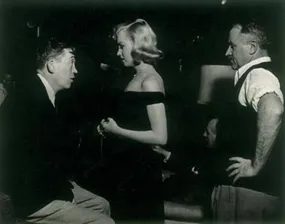

The preparation for that specific audition wasn’t casual. It was grueling. Marilyn spent three days and nights with drama coach Natasha Lytess, dissecting the material until her interpretation was razor-sharp. They weren’t just memorizing lines. They were building a person.
The role in question was Angela Phinlay. On paper, she was the mistress of a crooked lawyer involved in a jewel heist. But Hollywood in the late 1940s had strict rules. The Production Code hated the word “mistress.” It was morally questionable. So the script sanitized it. Angela became the lawyer’s “niece.”
The truth was buried under bureaucratic censorship. But Marilyn? She knew what she was playing.
The audition took place on a soundstage at MGM. John Huston was in charge. He expected a standard reading. He did not expect Marilyn to ask for permission to lie down.
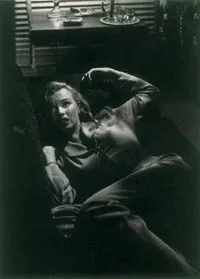
She wanted to recline on the floor. She argued it was the only way to capture the character’s lethargy and detachment. Huston agreed.
It was a gamble. Most actors stand up. They project. They perform for the room. Marilyn hit the concrete. She let the floor do the heavy lifting.
When she finished, the silence in the room was heavy. Huston didn’t clap. He didn’t offer praise. He just stared.
Then came the ask. She wanted to do it again.
One more time.
Huston let her try. But the second reading didn’t change the outcome. He had already made up his mind during the first attempt.
Why Huston Caved
This wasn’t luck. Johnny Hyde had pulled strings. He had worked behind the scenes to get Marilyn in the room. He had fought for her when no one else would.
Huston knew this. He acknowledged the industry connections. But he also knew the talent.
“Marilyn didn’t get the part because of Johnny. She got it because she was damned good.”
That quote matters. It separates the industry myth from the reality.
Hyde opened the door. Marilyn walked through it on her own terms.
The character of Angela Phinlay was small. A “niece” in a script that lied about her status. But the performance was real. She didn’t need the censors’ approval to be compelling. She didn’t need the word “mistress” to convey the character’s moral ambiguity.
She just needed to lie down and tell the truth.
Huston saw it. That was the point.
The role launched her into the spotlight. Not because of who she knew. But because of what she did in that room.
Does that kind of instinct still exist in auditions today? Or do we just stand up and project now?

Huston’s Vision and the Asphalt Jungle
Marilyn Monroe’s path to stardom wasn’t a straight line. It zigzagged through rejections, test screenings that never happened, and directors who saw something others missed. John Huston was one of those directors. Their paths crossed at Columbia when he considered her for a part opposite John Garfield. The test never happened. Why? The files are quiet on that.
Maybe it was cost. Testing an unknown for a single role in a gritty crime film sounds like a budget nightmare. Maybe an executive with more power than Huston nixed it. Or maybe it was darker. Some whispers suggest Marilyn was being set up for the “casting couch,” a dirty word in Hollywood lore. If that’s true, Huston pulled the plug himself. He refused to play that game.
Whatever the reason, Huston kept her in his mental Rolodex. When The Asphalt Jungle needed casting, he didn’t look at the biggest stars. He looked at talent. He remembered Marilyn.
A Star Among Heavyweights
The Asphalt Jungle wasn’t a blockbuster by today’s standards. It was a hard-bitten, gritty crime drama. Huston directed it with taut precision. The cast had no major box-office draws. Instead, it featured heavy hitters: Sterling Hayden, Louis Calhern, Sam Jaffe, and Jean Hagen.
How did Marilyn hold her own against that lineup?
It was a testament to her work. Huston understood her image. He knew how to use it. Other directors later exploited her look. Huston used it to build character. He saw the complexity in her face, something many less talented directors missed entirely.
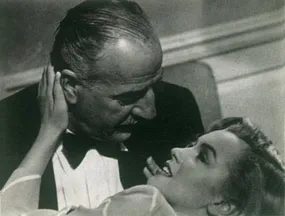
In the film, Marilyn played Angela Phinlay. She wasn’t a villain. She wasn’t a scheming femme fatale. Yet, she ruined the lawyer played by Louis Calhern. His obsession with her—treating her like a priceless possession—cost him everything. The money drained. The risks mounted. The downfall was inevitable.
The Eroticism of Innocence
Huston’s films often share a pattern. A group of men chases a quest. It ends in failure. Usually, a woman distracts them from the goal. Angela was that distraction. But Marilyn’s portrayal wasn’t conniving. It was erotic innocence. That simplicity made Angela real. It made the lawyer’s obsession believable.
Her performance in The Asphalt Jungle changed things. Natasha Lytess, her acting coach, was so impressed she quit her job at Columbia to coach Marilyn full-time. Hollywood insiders who had doubted Johnny Hyde’s faith in Marilyn started to look closer. They saw potential.
Yet, the major studios stayed silent. No handsome offers came in. Not yet.

It was a twist of fate that felt almost scripted, though real life rarely gets the production value of a Hollywood comedy. Jim Dougherty, Marilyn’s ex-husband, was working as a Los Angeles police officer by then. His assignment? Keep the screaming fans behind the barricades at Grauman’s Egyptian Theater. The Asphalt Jungle premiere was in full swing.
Dougherty watched the limousines roll up. He hoped to catch a glimpse of Norma Jeane. He didn’t know she wasn’t there.
Hyde had advised her against attending. She took the advice.
It wouldn’t have mattered anyway. Even if she had shown up, Jim wouldn’t have recognized Norma Jeane. He would have seen Marilyn Monroe. The transformation was complete. The girl from the past was gone.
The Small Role That Led Somewhere Else
If you think Asphalt Jungle was her big break, you’re mistaken. It was a bit part. A footnote in a John Huston film. But the real pivot point came shortly after.
Marilyn landed a role in All About Eve. She played Miss Caswell.
The part was small. Tiny, really. Just a secretary with a few lines. But it placed her in front of the right people. Bette Davis. Anne Baxter. George Sanders. The elite of Hollywood.
“It was not really Norma Jeane that Jim Dougherty would have seen anyway.”
This role proved she could work on set. It showed she could handle a major production. It wasn’t the stardom yet. It was the proof of concept.
Why All About Eve Matters
People often skip over Miss Caswell. They talk about Gentlemen Prefer Blondes or The Seven Year Itch. But All About Eve was the step that made the next ones possible.
- Exposure: She was on screen with legends.
- Professionalism: She held her own.
- Visibility: Industry insiders noticed the quiet blonde.
The premiere at Grauman’s Egyptian was a public spectacle. The premiere of her career was much quieter. It happened on set. It happened in the margins.
Jim Dougherty saw the barricades. He saw the crowds. He didn’t see the girl he left behind. He saw the star who never arrived.
The next chapter wasn’t about police work. It was about learning how to stand next to Bette Davis. And survive.
Miss Caswell was the test. Marilyn passed.

